
General News
Nigeria Moves to Decriminalise Attempted Suicide as Tinubu Sends Mental Health Bill to Senate


Nigeria is taking steps towards ending the criminal punishment of people who survive suicide attempts, following President Bola Ahmed Tinubu’s submission of a proposed amendment to the country’s mental health legislation.
The proposed National Mental Health Amendment Bill, 2026, seeks to remove criminal liability for attempted suicide and strengthen provisions for medical care, rehabilitation and support for survivors.
Tinubu transmitted the bill to the Senate earlier this week, with his letter formally presented during plenary by Senate President Godswill Akpabio. The proposal is expected to amend the National Mental Health Act of 2021.
Under existing provisions of Nigeria’s Criminal Code and Penal Code, attempted suicide remains a criminal offence, with offenders potentially facing imprisonment, fines or both, depending on the applicable law.
The proposed reform is intended to change that approach, shifting the response from criminal prosecution towards mental healthcare and support for people experiencing psychological distress.
The move comes amid growing calls from mental health professionals and lawmakers for the country to reconsider the criminalisation of suicide attempts. Advocates have argued that the threat of prosecution may discourage people in crisis from seeking help and could lead families to conceal incidents because of fear of stigma or legal consequences.
A separate legislative proposal sponsored by Senator Asuquo Ekpenyong has also been under consideration in the Senate, seeking to establish a stronger framework for suicide prevention, treatment and rehabilitation. That bill has already passed a second reading, adding momentum to the reform debate.
Senate President Akpabio has expressed support for the proposed change, acknowledging that people facing mental health difficulties require assistance rather than punishment.
The presidential bill has now been referred for further legislative consideration. Its passage would mark a significant change in Nigeria’s legal response to attempted suicide, although the proposed amendment has yet to become law.
The reform debate is part of a broader effort to strengthen mental health awareness, reduce stigma and encourage people experiencing psychological distress to seek support.












General News
Jospong’s AAC Partners Turkish ChitoGlobal to Introduce Shell-Based Crop Treatments in Ghana

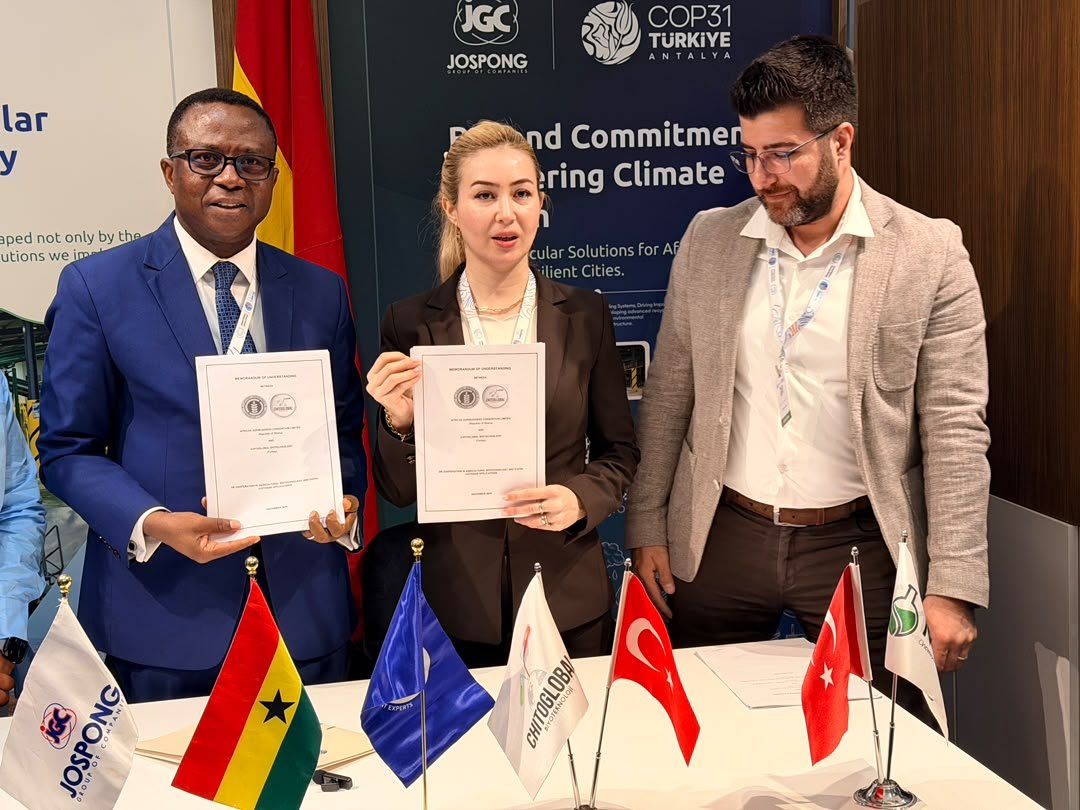
The African Agribusiness Consortium Limited (AAC), a subsidiary of the Jospong Group of Companies, has entered into a strategic partnership with Türkiye-based ChitoGlobal Biotechnology to explore innovative agricultural treatments produced from discarded shrimp and crab shells to improve crop production in Ghana.
The partnership, formalised through the signing of a Memorandum of Understanding (MoU) at COP31 in Antalya, Türkiye, seeks to introduce environmentally friendly agricultural solutions that could help Ghanaian farmers improve crop yields, manage plant diseases and reduce their dependence on conventional chemical treatments.

Under the agreement, the two organisations will undertake joint research and field trials in Ghana to determine the effectiveness of chitosan-based agricultural products under local farming conditions.
Chitosan is a natural substance derived from chitin, which is commonly found in the shells of crustaceans such as shrimp and crabs. The material is being explored for its potential to improve agricultural productivity while supporting more sustainable farming practices.
The initial phase of the collaboration will focus on examining how the products can protect seeds and growing plants, strengthen crops against fungal infections and improve their ability to withstand periods of limited rainfall.
Researchers will also assess the potential effects of the treatments on soil quality, crop development and overall yields, particularly in areas where farmers face challenges associated with changing weather conditions and declining soil fertility.
The partnership is expected to explore whether these biological products could provide a more affordable and environmentally sustainable alternative to certain conventional agricultural inputs currently used by farmers.
Speaking after the signing ceremony, the Chief Investment and Innovation Officer of the Jospong Group of Companies, Mr Noah Gyimah, expressed optimism about the collaboration and its potential to transform agricultural practices in Ghana.

He explained that the Group would engage Ghana’s environmental and standards regulatory authorities to ensure that the proposed products meet the necessary safety and quality requirements before their introduction onto AAC farms.
According to him, the partnership represents an important opportunity to move innovative agricultural technology beyond laboratory research into practical applications that could benefit commercial farmers and smallholder producers.
“Our joint efforts will transition this technology from research and development to practical application. We will commence with collaborative research and field trials in Ghana, followed by technology transfer and full-scale commercial production,” he stated.
Mr Gyimah indicated that the pilot programme would provide an opportunity to determine the commercial viability of the products, assess potential demand within Ghana’s agricultural market and identify prospective buyers.
He further explained that the research would establish whether sufficient raw materials could be sourced locally to support the eventual establishment of production facilities in Ghana.
The Chief Investment and Innovation Officer noted that AAC intends to make the products accessible to smallholder farmers across the country if the research and field trials demonstrate their effectiveness, safety and suitability for Ghanaian agricultural conditions.
Beyond supporting smallholder farmers, he disclosed that the consortium also plans to incorporate the treatments into its large-scale commercial farming operations, particularly in the cultivation of crops and vegetables intended for the Ghanaian market.
The initiative, he explained, forms part of broader efforts to strengthen agricultural productivity, improve food production and explore sustainable technologies capable of supporting Ghana’s growing food requirements.
On her part, the Sales and Technical Support Manager of ChitoGlobal Biotechnology, Dana Abourahma, welcomed the partnership, describing it as an opportunity to combine advanced biotechnology research with practical agricultural experience in Ghana.
“This collaboration brings together extensive local knowledge with cutting-edge scientific capabilities,” she said.

She indicated that the partnership would allow both organisations to draw on their respective strengths in agricultural production, biotechnology and technical research to explore solutions suitable for Ghana’s farming environment.
The agreement followed a working visit by a four-member delegation from AAC to ChitoGlobal Biotechnology’s facility in Antalya, Türkiye.
The delegation was led by AAC’s Coordinator, Dr Emmanuel Volsuuri, who explained that the visit was arranged following his initial engagement with representatives of the Turkish biotechnology company at its pavilion during COP31.
According to Dr Volsuuri, discussions at the pavilion generated interest in the company’s agricultural innovations, prompting further engagements that eventually created an opportunity for the AAC delegation to visit its facility and obtain firsthand information about its operations.
During the visit, the delegation toured the company’s laboratories and other operational facilities to gain a deeper understanding of the composition, development and potential agricultural applications of its biotechnology products.
The team also interacted with technical personnel to learn about the processes involved in developing the chitosan-based treatments and how the technology could potentially be adapted to Ghana’s agricultural conditions.
Dr Volsuuri explained that the visit was particularly important because AAC was interested in identifying innovative methods of managing crop diseases, improving soil health and supporting agricultural production without excessive reliance on conventional chemical treatments.
He expressed concern about the widespread application of certain chemical products in agricultural production, particularly vegetable cultivation, and the potential risks associated with improper or excessive use.
According to him, the increasing dependence on chemical treatments in some farming activities makes it necessary to explore alternative technologies that could help protect crops while promoting safer and more sustainable food production.
He noted that the proposed collaboration would provide an opportunity to investigate whether chitosan-based products could contribute to addressing these concerns through improved plant protection and soil management.
Dr Volsuuri emphasised that the partnership would not only focus on introducing new agricultural products but would also create opportunities for knowledge sharing, scientific research and technology transfer between Ghana and Türkiye.
He explained that the collaboration could eventually support local manufacturing if the trials establish that the products are effective, commercially viable and suitable for Ghanaian farming conditions.
Dr Volsuuri further indicated that AAC, under the leadership of its Chief Executive Officer, Dr Adelaide Araba Siaw Agyepong, is actively involved in commercial agricultural production across Ghana.
The consortium currently cultivates crops including rice, maize, soybeans and vegetables on a commercial scale as part of its efforts to contribute to domestic food production and agricultural development.
In addition to its farming operations, AAC supports farmers through access to agricultural mechanisation services, financing opportunities and markets for their produce.
These interventions are intended to help address some of the major challenges confronting farmers, including limited access to modern farming equipment, inadequate financial resources and difficulties securing reliable markets.
Dr Volsuuri explained that AAC’s involvement in both large-scale farming and smallholder agricultural support makes it a suitable partner for testing and potentially introducing innovative agricultural technologies into Ghana.

He added that ChitoGlobal Biotechnology’s experience in developing biopolymers for agricultural and medical applications further strengthens the prospects for scientific collaboration between the two organisations.
According to him, combining AAC’s understanding of Ghana’s agricultural environment with ChitoGlobal’s biotechnology expertise could help identify practical solutions to challenges affecting crop productivity and sustainable farming.
The proposed field trials will be essential in determining whether the treatments can deliver measurable improvements in crop performance, soil conditions and disease management before any decision is made regarding commercial production or wider distribution to farmers.
General News
COPTI 2026 Conference in Wa Sets New Agenda for Ghana’s TVET and Industrial Development

In an article written by Seth Afum A. Dankwah of J. G. Knol Technical Institute, Adukrom-Akuapem, in the Eastern Region, he highlighted the major developments, challenges and commitments emerging from the 2026 COPTI Annual Conference, stressing the need to position technical education at the centre of Ghana’s industrial transformation.
The conference, held from November 15 to 20, 2026, at the Wa Technical Institute in the Upper West Region, was organised under the theme, “The New Face of TVET: Our Institutions, Our Industry, and Our Future.”
The six-day gathering brought together principals of technical institutions, policymakers, traditional authorities, industry representatives and development partners to discuss strategies for transforming technical education into a major contributor to Ghana’s economic and industrial growth.
According to the writer, the conference represented more than an annual gathering, as it provided an important platform for stakeholders to address longstanding challenges confronting technical institutions while exploring opportunities for employment creation and industrial development.
Opening the conference, the National President of COPTI, Architect Arko Dometey, stressed the importance of collaboration among technical institutions, government agencies and industry players in transforming the sector.
He explained that technical education must no longer be regarded as an alternative reserved for students who are unable to enter traditional secondary schools.
According to him, Ghana’s industrial ambitions require a strong technical workforce equipped with practical knowledge, modern skills and the ability to respond to changing technological demands.
He therefore urged stakeholders to work towards positioning TVET institutions at the centre of the country’s economic and industrial development.
The COPTI President also highlighted the need for reforms that would make technical education more attractive to young people while creating stronger connections between classroom instruction and workplace experience.
The Paramount Chief of Dorimon, Naa Alhaji Seidu Tungbani Salinbile II, challenged the perception that grammar schools offer better educational opportunities than technical institutions.
He argued that technical skills and vocational trades remain important sources of employment, entrepreneurship and wealth creation.
The traditional ruler encouraged parents and students to recognise the economic opportunities available through technical education rather than viewing it as an inferior academic pathway.
While commending the government for introducing the new Science, Technology, Engineering and Mathematics (STEM) curriculum and implementing the Free Senior High School policy, he called for greater investment in educational infrastructure, particularly in less-endowed institutions.
He warned that educational reforms would struggle to achieve their intended results if schools in rural and underserved communities continued to operate without adequate facilities.
In his article, Seth Afum A. Dankwah drew attention to the difficulties experienced by several technical institutions across Ghana, including J. G. Knol Technical Institute at Adukrom-Akuapem in the Eastern Region, where inadequate training facilities and equipment remain challenges.
The Vice-Chancellor of Dr Hilla Limann Technical University, Ing. Prof. Hamidatu Saaka Darimani, called for a comprehensive rebranding of technical and vocational education to make it a preferred career option for young Ghanaians.
She stressed that the success of TVET institutions should not be measured solely by the number of students who complete their programmes.
Instead, she advocated greater attention to graduate employment, entrepreneurship and the practical application of skills acquired during training.
Her position highlighted the need for technical institutions to produce graduates capable of securing employment, establishing businesses and contributing meaningfully to national development.
The Vice-Chancellor further emphasised the importance of aligning training programmes with industry requirements to prevent situations where students complete their education without possessing the skills employers need.
One of the major developments announced during the conference was the significant increase in student enrolment in Ghana’s technical and vocational education sector.
The Director-General of the Ghana TVET Service, Engineer Dr Eric Kofi Adzroe, disclosed that enrolment had increased from approximately 33,500 students during the 2019/2020 academic year to about 72,200 in the 2025/2026 academic year.
The figures represent an increase of approximately 116 per cent over the period.
Despite the growth, Dr Adzroe acknowledged that more work was required to expand participation in technical education nationwide.
He explained that the government was working towards increasing national TVET participation to 20 percent of the relevant student population.
“We are steadily working toward the government’s broader ambition to increase national TVET participation to 20 per cent, ensuring no learner, especially women and girls, is left behind,” he stated.
He also announced that 83 infrastructure projects funded through the Ghana Education Trust Fund (GETFund) had commenced across 13 regions.
The projects are expected to support efforts to improve the learning environment and expand facilities for technical training.
Dr Adzroe further disclosed plans to launch a dedicated TVET Fund in January 2027 to provide more sustainable financial support for technical and vocational institutions.
The proposed fund is expected to address longstanding concerns about inadequate resources, including the shortage of training equipment, modern workshops and instructional materials.
For years, principals of technical institutions have raised concerns about the financial difficulties affecting practical training.
The planned funding arrangement could therefore become an important intervention in efforts to strengthen the sector, provided resources are made available and distributed effectively.
The Director-General also reiterated the importance of increasing female participation in technical education, particularly in traditionally male-dominated fields.
A major highlight of the conference was the announcement of a partnership between COPTI and e-mobility company E Moto to support skills development in Ghana’s emerging electric vehicle industry.
The collaboration will focus on establishing an assembly facility and developing a specialised curriculum to prepare students for employment in the e-mobility sector.
Chief Operating Officer of E Moto, Mr Robert Lawson, disclosed that a single assembly plant could require as many as 240 skilled workers.
He further indicated that the broader e-mobility ecosystem had already created more than 2,500 jobs through two-wheeler and three-wheeler transport solutions.
“We need to set up a curriculum for e-mobility, and we are developing that in partnership with COPTI to come up with a course where students can study and have a specialised course for e-mobility,” he explained.
The proposed curriculum is intended to equip students with specialised knowledge and practical skills relevant to electric mobility technology.
The partnership also demonstrates the opportunities available when technical institutions collaborate directly with businesses to design training programmes around industry needs.
As part of its plans, E Moto announced the development of a green-energy tricycle designed to support women entrepreneurs.
The initiative seeks to create opportunities for women to establish transport-related businesses and participate in the growing electric mobility industry.
Mr Lawson also called on the government to introduce tax incentives for manufacturers and operators involved in two-wheeler and three-wheeler production.
He argued that the sector deserved greater policy attention because of the significant role motorcycles and tricycles play in transportation and economic activities across Ghana.
According to him, favourable government policies could encourage investment, expand local assembly operations and create additional employment opportunities for technically trained young people.
Despite the positive developments announced during the conference, COPTI expressed serious concern about the inadequate supply of practical training equipment in technical institutions.
Speaking on the closing day, Architect Arko Dometey highlighted the difficulties faced by institutions operating with obsolete machinery, insufficient tools and limited training materials.
He explained that the situation was affecting the quality of practical instruction, with some institutions compelled to teach subjects theoretically because the necessary equipment was unavailable.
The shortage of modern tools also limits students’ exposure to technologies currently being used in industry.
COPTI therefore called for urgent investment in workshops, machinery, instructional equipment and consumable materials to improve the quality of technical education.
The association maintained that constructing school buildings alone would not address the challenges facing the sector unless institutions were also provided with the resources required for effective practical training.
Seth Afum A. Dankwah, in his account of the conference, highlighted the relevance of these concerns to institutions such as J. G. Knol Technical Institute in Adukrom-Akuapem, where improved facilities and modern equipment would support efforts to deliver industry-relevant technical training.
Although a formal conference communiqué had not been widely circulated, several priorities emerged from the discussions.
Among them was the need to position TVET as a central component of Ghana’s industrial development strategy rather than a secondary educational option.
Participants also emphasised stronger partnerships between technical institutions and industry to improve curriculum development, workplace training and employment opportunities.
Other major priorities included increased investment in modern training equipment, sustainable institutional funding, improved infrastructure and the promotion of technical education as a respected career pathway.
The conference further highlighted the importance of supporting the government’s 20 per cent TVET participation target, implementing the 83 GETFund infrastructure projects and operationalising the proposed TVET Fund.
Special attention was also given to expanding opportunities for women and girls in technical education.
The proposed COPTI–E Moto partnership emerged as another important initiative, with stakeholders calling for practical implementation of the specialised e-mobility curriculum and associated industry development plans.
The WA conference followed an earlier engagement between COPTI representatives and the leadership of the Commission for Technical and Vocational Education and Training (CTVET).
The closed-door working meeting, held on November 12, 2026, focused on key issues affecting the implementation of technical education reforms.
Discussions covered accreditation, institutional funding, Competency-Based Training (CBT) and measures to improve the delivery of technical and vocational programmes.
The engagement provided an opportunity for the two bodies to examine challenges affecting the sector before the broader discussions at the annual conference.
Competency-Based Training remains particularly important because it places emphasis on demonstrated practical skills and occupational competence rather than theoretical knowledge alone.
The discussions in Wa also drew attention to the relationship between technical education, industrialisation and youth employment in Ghana.
With industries such as construction, manufacturing, agro-processing, renewable energy and transportation requiring specialised skills, stakeholders stressed the importance of developing a workforce capable of meeting these demands.
They argued that stronger technical institutions could help reduce the mismatch between the skills acquired by graduates and the qualifications employers require.
The proposed expansion of e-mobility training was identified as one example of how technical education could respond to emerging employment opportunities.
Participants also emphasised the importance of entrepreneurship training to enable graduates to establish businesses rather than depend entirely on formal employment.
In his article, Seth Afum A. Dankwah underscored the significance of the Wa conference in shaping the future of technical education, noting that the success of the commitments made would depend on their practical implementation.
He highlighted the importance of addressing inadequate infrastructure, obsolete equipment and limited industry collaboration to ensure that Ghana’s technical institutions can produce the skilled workforce needed for industrial growth.
The 2026 COPTI Annual Conference, which ended on November 20, placed renewed attention on the need for government, industry and educational institutions to translate reform commitments into practical improvements in Ghana’s technical education system.
Entertainment
GTA VI Rakes in $3.79 Billion in One Day, Sets Record for Biggest Entertainment Launch

Grand Theft Auto VI (GTA VI) has made history after generating an estimated $3.79 billion in retail sales within its first 24 hours, marking what its publisher describes as the biggest entertainment launch ever recorded.

Lucia Caminos official character artwork.
The figures, announced by Rockstar Games on Friday, November 20, place the highly anticipated title at the top of the global entertainment industry’s launch records, surpassing previous benchmarks set by major video games and blockbuster films.
The game reportedly accumulated 32.5 million sales before its official release, reflecting the extraordinary demand that built up during the years leading to its launch.

Vice City-inspired skyline and neon streets.
According to Rockstar Games, the first-day sales figure was based on company estimates through the end of Thursday, November 19, the game’s launch day.
The performance represents a major leap over its predecessor, Grand Theft Auto V, which generated approximately $800 million in its first 24 hours in 2013.
GTA VI’s reported opening sales are also greater than the worldwide box-office earnings of Avengers: Endgame, which grossed approximately $2.9 billion over its theatrical run.

In-game action scene featuring vehicles and the city.
The new title, set in the fictional state of Leonida and featuring the city of Vice City, follows protagonists Lucia Caminos and Jason Duval as they navigate a criminal underworld. The game has attracted attention for its expansive world, detailed environments and storyline.
The launch has also drawn widespread attention from gamers across several countries, with reports of heavy online activity and players staying up through the night to access the title.

Rockstar Games and GTA VI branding.
The record-breaking performance further underscores the growing commercial influence of the gaming industry, where major releases increasingly compete with film, music and other entertainment sectors for global audiences and revenue.
With its opening-day performance already setting a historic benchmark, GTA VI has established itself as one of the most commercially significant entertainment releases ever.

The White House has replaced its top cybersecurity official, Sean Cairncross, following a series of technology disruptions that affected critical services across the United States, including banking, air travel and government systems.
Cairncross, who served as the National Cyber Director since August 2025, is reportedly leaving the position after losing the confidence of White House Chief of Staff Stephen Miller. US President Donald Trump also reportedly backed the decision, with reports indicating concerns about Cairncross’ qualifications for the role.
The Pentagon’s Chief Information Officer, Kirsten Davies, has been appointed to take over the cybersecurity leadership role in an acting capacity. Her appointment comes as the administration faces growing scrutiny over a series of outages that disrupted technology services in several sectors.
Recent incidents reportedly affected air traffic control systems, banking services, communications infrastructure and other technology platforms, raising concerns about the reliability of systems relied upon by millions of Americans.
The disruptions have triggered questions from lawmakers and members of the public about the vulnerabilities of critical infrastructure and the government’s preparedness to respond to widespread technology failures.
However, US officials have maintained that there is no evidence linking the incidents to a coordinated cyberattack. Officials have suggested that technical problems, system maintenance and software updates may have contributed to some of the disruptions.
The leadership change comes at a time when cybersecurity has become increasingly important to national security, particularly as government agencies and businesses rely more heavily on interconnected digital infrastructure and emerging artificial intelligence technologies.
Davies is expected to oversee efforts to strengthen cybersecurity coordination and improve the resilience of critical systems as the administration navigates growing concerns over technology reliability.

Nearly 600 women were killed in South Africa between July and September 2026, according to newly released police crime statistics, renewing concerns over gender-based violence and the safety of women across the country.
Figures released by the South African Police Service (SAPS) on Friday showed that 581 women were murdered during the three-month period, with Gauteng province, which includes Johannesburg, accounting for 131 of the deaths.

A vigil or memorial honouring victims of violence against women.
The statistics come amid renewed national attention following the discovery of the bodies of 13 women in various locations across the Ekurhuleni area, east of Johannesburg, between July and September. The cases sparked public outrage and intensified calls for stronger action to protect women.
Police in Gauteng have announced eight arrests linked to the 13 killings. Investigators have linked several of the arrests to individual cases involving victims whose bodies were discovered in locations including Kempton Park, Tembisa, Boksburg, Olifantsfontein and Springs.

Police officers at a crime scene, representing the latest murder statistics.
The cases have further heightened public concern about the persistent violence confronting women in South Africa.
The latest figures also come after a deadly shooting in Botshabelo, in the Free State province, where five women and a toddler were reportedly killed after masked gunmen stormed a home. Police said the attackers were searching for the homeowner before forcing their way inside and opening fire. The homeowner’s wife was injured and taken to hospital, while no arrests had been reported in that case at the time of the report.

A city street scene in Johannesburg for a general news illustration.
South Africa recorded 5,590 murders overall during the July–September period, 204 fewer than in the corresponding period last year. Despite the decline, the figures represent an average of approximately 60 murders per day.
Acting Police Minister Firoz Cachalia called for stronger efforts to prevent violence against women and children, as authorities face mounting pressure to address the country’s persistent violence crisis.
The latest figures have once again brought the issue of women’s safety, accountability and prevention of gender-based violence into sharp focus across South Africa.


Jospong’s AAC Partners Turkish ChitoGlobal to Introduce Shell-Based Crop Treatments in Ghana

Why Do We Save Our Best Things for Special Occasions That Never Come?

COPTI 2026 Conference in Wa Sets New Agenda for Ghana’s TVET and Industrial Development

Davido to Support Nigerians with Start-Up Capital as Part of Birthday Celebration

GTA VI Rakes in $3.79 Billion in One Day, Sets Record for Biggest Entertainment Launch

NADFFA 2027: Ghana to Host Pan-African Film and Food Festival in March

GTA Staff Demand Answers on World Cup Visa Slots, Staff Dismissals and Unpaid Allowances

Nicki Minaj Throws Her Support Behind Trump Ahead of US Midterm Elections

SAMMY GYAMFI’S “MINE WITHOUT LICENCE” REMARK SPARKS FRESH GALAMSEY DEBATE

FOKLEX MEDIA AWARDS COMMENDS PRINCE KWAW GYIMAH AND OWASS FM TEAM FOR PROFESSIONALISM DURING KWAME DZOKOTO INCIDENT

Illinois’ financial crisis could bring the state to a halt
The final 6 ‘Game of Thrones’ episodes might feel like a full season
New Season 8 Walking Dead trailer flashes forward in time
Mod turns ‘Counter-Strike’ into a ‘Tekken’ clone with fighting chickens
Meet Superman’s grandfather in new trailer for Krypton

-

 General News15 hours ago
White House Removes Cybersecurity Chief Amid Series of Technology Outages
-

 General News15 hours ago
South Africa’s femicide crisis: Nearly 600 women dead in three months
-
 Entertainment14 hours ago
GTA VI Rakes in $3.79 Billion in One Day, Sets Record for Biggest Entertainment Launch
-
 General News13 hours ago
COPTI 2026 Conference in Wa Sets New Agenda for Ghana’s TVET and Industrial Development
-

 Business24 hours ago
GSS: Ghanaian Workers Produce Nearly Three Times More, but Wages Lag
-

 Business24 hours ago
Producer Inflation Picks Up to 5.2%, Raising Cost Concerns
-
 Lifestyle11 hours ago
Why Do We Save Our Best Things for Special Occasions That Never Come?
-
 Entertainment14 hours ago
Davido to Support Nigerians with Start-Up Capital as Part of Birthday Celebration