
Entertainment
NADFFA 2027: Ghana to Host Pan-African Film and Food Festival in March


The festival, scheduled for March 12 to 14, 2027, will bring together filmmakers, actors, food entrepreneurs, corporate organisations, investors, tourism stakeholders and members of the African Diaspora to celebrate African creativity and create business opportunities across the continent.
The Chief Executive Officer and Global Ambassador of NADFFA, Ms Ramatu Gumah, announced the programme during the festival’s Corporate and Media Launch held on Thursday, October 29, 2026, at the W.E.B. Du Bois Memorial Centre for Pan-African Culture in Cantonments, Accra.
Addressing dignitaries, members of the diplomatic corps, traditional authorities, government representatives, corporate stakeholders, tourism and hospitality leaders, media practitioners and members of the creative arts industry, Ms Gumah described the launch as more than an event, saying it represented a declaration of Africa’s readiness to own its narrative, promote its cuisine, tell its stories and recognise excellence on the global stage.
Explaining the vision behind the initiative, Ms Gumah said NADFFA had been deliberately established as a Pan-African platform bringing together five major pillars: African cinema, African cuisine, culture, tourism and creative excellence.
She stressed that the festival was not simply another entertainment event but a strategic initiative designed to promote economic opportunities, enhance corporate visibility, develop tourism, strengthen cultural diplomacy and encourage investment networking.
According to her, NADFFA seeks to connect African creative products to markets, provide corporate brands with a premium Pan-African platform and position Ghana as a gateway to African culture.
She further explained that the initiative would strengthen relationships between Ghana, Nigeria, the wider African continent and the Diaspora while creating opportunities for creatives, businesses, investors and policymakers to collaborate.
“We are building an ecosystem where film meets finance, where food meets tourism, and where culture meets commerce,” she stated.
Presenting the roadmap for the 2027 edition, Ms Gumah announced that the main Film and Food Festival would take place on March 12 and 13, 2027, at the forecourt of the State House in Osu, Accra.
The two-day event is scheduled to run from 10:00 a.m. to 4:00 p.m. each day.
She said the festival would transform the venue into a hub for African cuisine and cinema, offering participants an opportunity to experience the continent’s rich cultural and creative heritage.
Activities will include exhibitions of authentic African cuisines, film screenings, masterclasses, cultural performances, fashion displays, art exhibitions and tourism expos.
The programme will also feature business-to-business engagements aimed at connecting Ghanaian, Nigerian and Diaspora enterprises and creating opportunities for partnerships and commercial collaborations.
The festival will climax on Sunday, March 14, 2027, with a grand awards night at the Mövenpick Ambassador Hotel in Accra.
The ceremony is scheduled to begin at 7:00 p.m. and run until 1:30 a.m.
Ms Gumah said the awards night would celebrate outstanding personalities and organisations making significant contributions to the promotion of Africa through entertainment, culture and business.
Award recipients will include actors, filmmakers, food entrepreneurs, cultural icons and corporate brands whose work projects a positive image of Africa to the international community.
She described the occasion as a night of glamour, honour and Pan-African pride, adding that the event would receive broadcast coverage and generate international attention.
The NADFFA CEO also used the launch to appeal to corporate organisations to support the initiative, highlighting the potential benefits of associating with a major Pan-African cultural platform.
She explained that partnerships with the festival would offer businesses access to markets in Ghana, Nigeria and the African Diaspora, which she described as comprising more than 170 million Africans.
According to her, corporate partners would also benefit from direct engagement with young people, creatives and consumers, as well as opportunities to align their brands with Ghana’s Black Star Experience and tourism development agenda.
She added that supporting NADFFA would provide organisations with an opportunity to demonstrate corporate social responsibility through initiatives that empower creative industry players.
Ms Gumah called on the government, corporate sector, diplomatic community, media organisations and the entire film fraternity to support the festival and help establish it as a major platform for African cultural and creative exchange.
She emphasised the importance of building connections between Nollywood, Ghallywood and Hollywood while creating opportunities to take African cuisine to international markets and connect creative talent with investment.
She further announced that the organisers were open to sponsorships, partnerships, exhibition bookings, film submissions and vendor registrations ahead of the March 2027 event.
Expressing appreciation to the NADFFA Board, organising team, media partners and guests who attended the launch, she said preparations were underway to make the festival a successful celebration of African identity and excellence.
“We are ready. Ghana is ready. Nigeria is ready. Africa is ready,” she declared.
She concluded by calling for continued support for African cinema and stronger unity between Africa and its Diaspora.
“Long Live Ghanaian Film! Long Live Nollywood-Africa! Long Live Africa-Diaspora Unity!” she said.















Entertainment
Before WhatsApp, Ghanaians Wrote Letters: The Beautiful Tradition We Are Slowly Forgetting

Before WhatsApp, there was a time when receiving a letter was something special.
A person could hear a knock at the door, receive an envelope from a postman and spend the next few minutes wondering who had written to them. Some letters carried exciting news, others brought greetings from loved ones far away, while a few contained words that people would keep for years.
Before WhatsApp messages, Facebook chats and video calls became part of everyday life, writing letters was one of the most meaningful ways Ghanaians stayed connected.
People took time to choose their words, write them down, fold the paper carefully, place it inside an envelope and send it through the post. Sometimes, the recipient had to wait several days or even weeks before hearing from the person who had written.
Today, communication is much faster. A message can travel from Accra to London in seconds, and a voice note can make someone feel close even when they are thousands of kilometres away.
But somewhere along the way, the personal experience of writing and receiving letters has become less common.
It raises an interesting question: have we gained convenience at the expense of something beautiful?
For many older Ghanaians, letters were an important part of maintaining relationships.
People living in different towns, regions or countries used handwritten letters to communicate with parents, siblings, friends and romantic partners.
A young person who travelled to Accra for work or education could write home to explain how life was going. Someone working in another country could send news to family members and reassure them that everything was well.
For students in boarding schools, letters were particularly meaningful. During holidays, some would write to parents and relatives, sharing stories about school life, friendships, examinations and personal experiences.
Receiving a letter could bring excitement because it represented an effort someone had made to stay connected.
Unlike a short text message sent in a hurry, a handwritten letter often carried several thoughts, questions and personal details. The writer had the opportunity to explain things fully, while the recipient could read the words repeatedly.
Some people even kept letters under their mattresses, inside books, in drawers or in carefully arranged boxes.
They were not simply pieces of paper. They were memories.
The postman everyone waited for
In many communities, the arrival of the postman was an event people noticed.
Residents knew the postman who delivered letters to their homes, workplaces or institutions. For some households, seeing the postman approaching created anticipation, especially when a family member was expecting news from someone far away.
A letter could come from a relative working in another region, a friend studying abroad or someone who had travelled for an extended period.
The envelope itself sometimes carried excitement before it was even opened.
People checked the sender’s name, examined the handwriting and carefully opened the envelope to read what was inside.
Today, postal services still play important roles in Ghana, but personal correspondence has largely moved to digital platforms. Many people now associate the post office more with parcels, official documents and business transactions than handwritten messages between loved ones.
The familiar excitement of waiting for a personal letter is no longer a regular experience for many households.
One of the most interesting parts of the old letter-writing culture was how it shaped romantic relationships.
Before couples could exchange instant messages throughout the day, letters provided an opportunity to express affection, admiration and commitment.
A young man interested in a woman might carefully write a letter explaining his feelings. A woman could respond with her own thoughts, questions and expectations.
For couples separated by distance, letters helped maintain emotional connections.
Some people spent considerable time deciding what to write because they wanted their words to be meaningful. A letter could be read several times, kept as a reminder of a relationship and revisited long after it was received.
There was also the suspense of waiting for a reply.
Unlike today’s communication, where someone can notice immediately that a message has been read, letter writing required patience. The writer had to wait for the response, sometimes without knowing exactly when it would arrive.
Modern relationships have different ways of expressing affection, but handwritten letters offered a personal touch that digital conversations do not always reproduce.
The beauty of handwriting
Another thing that made letters special was the handwriting itself.
People had different writing styles. Some wrote in neat, carefully arranged letters, while others had handwriting that was difficult to read. Some decorated their letters with small drawings, underlined important words or used different coloured pens.
A person’s handwriting could become familiar to the people who received their letters regularly.
Even the way someone signed their name could make a letter feel personal.
Today, most everyday communication is typed. Messages often come with emojis, abbreviations, stickers and voice notes. These forms of communication have their own charm, but they rarely preserve the physical character of a person’s handwriting.
For some families, old letters have become valuable keepsakes because they preserve the handwriting of relatives who are no longer alive.
A handwritten note from a parent or grandparent can carry emotional significance beyond the words written on the page.
It is a physical reminder of someone who took time to communicate in their own hand.
Letter writing was not limited to romance and family greetings.
Ghanaians also relied on written correspondence for formal communication.
People wrote applications for jobs, requested information, sent invitations, submitted complaints and communicated with institutions through letters.
Students wrote applications for admission and scholarships. Workers submitted resignation letters and requests for leave. Families sent formal invitations for weddings, funerals and other important occasions.
Business owners and organisations used letters to communicate with customers, suppliers and government institutions.
Some of these practices remain important today, particularly in formal and professional settings. However, email and digital communication have replaced many of the handwritten exchanges that were once common.
The shift has made communication faster and easier to store, but it has also changed the way people experience written correspondence.
The decline of personal letter writing is closely connected to technological progress.
Mobile phones made communication more accessible, while the internet introduced email, instant messaging and social media.
Instead of writing a letter and waiting for it to be delivered, people could simply call or send a message.
Digital communication also reduced the cost and effort involved in keeping in touch with several people.
For families with relatives abroad, video calls made it possible to see and speak to loved ones without travelling or waiting for a letter.
Busy lifestyles have also influenced the change. Many people prefer short messages because they can communicate while working, travelling or attending to other responsibilities.
There is nothing wrong with these developments. Technology has made it easier for people to maintain relationships across long distances.
However, speed has become such an important part of communication that some people rarely take time to write thoughtful messages.
A conversation can begin and end within minutes, while a letter often required the writer to pause, reflect and organise their thoughts.
What happens to old letters?
For people who grew up writing and receiving letters, old envelopes can hold memories of different stages of life.
Some contain news from family members who have passed away. Others preserve childhood friendships, school experiences, romantic relationships and important family milestones.
A letter written decades ago can reveal how people spoke, what they worried about, what they hoped for and how they understood the world around them.
These documents can also provide valuable historical information about everyday life in Ghana.
They may contain references to old neighbourhoods, schools, workplaces, family traditions, prices, events and social experiences that are not always recorded in official history books.
Unfortunately, many old letters are discarded during house moves, renovations or family clean-ups. Others become damaged by moisture, insects and poor storage.
As a result, families may lose personal records that could have been meaningful to future generations.
Preserving important family letters, where appropriate, can help protect these memories. They can be kept in dry, safe places, placed in protective folders or digitised so that relatives can access them without handling fragile originals.
Could handwritten letters make a comeback?
Letter writing may no longer be the main way Ghanaians communicate, but that does not mean the practice has no place in modern life.
A handwritten birthday message, thank-you note, apology or letter to a loved one can still make someone feel appreciated.
Parents can encourage children to write letters to grandparents and relatives, especially those who enjoy receiving personal correspondence.
Schools can also use letter-writing activities to help pupils develop their writing skills, organise their thoughts and understand different forms of communication.
Couples and friends can occasionally exchange handwritten notes to make ordinary moments more memorable.
Ghana’s postal services and cultural organisations also have an opportunity to promote letter writing through activities that connect younger generations with the country’s postal history.
The aim is not to abandon technology or return to a time when communication was difficult. It is to recognise that not every meaningful conversation needs to happen instantly.
Perhaps the most beautiful thing about letter writing was the effort behind it.
Someone had to think about what they wanted to say, find paper, pick up a pen and spend time putting their thoughts into words. They then had to send the letter and trust that it would reach the intended person.
The recipient, in turn, had something physical to hold, read and preserve.
Today, we can send hundreds of messages in a day and still struggle to find the right words when someone needs encouragement or comfort.
Technology has given us speed, access and convenience, but handwritten letters remind us that communication is not only about delivering information. It is also about making people feel remembered.
Perhaps it is time to bring back the simple pleasure of writing a letter, even if it is only once in a while.
Imagine receiving an envelope from someone you love, opening it and discovering that they took time out of their busy day to write something just for you.
In a world where almost everything arrives through a screen, that small gesture could mean more than we realise.
When was the last time you received a handwritten letter, and would you still be excited to find one waiting for you?

Ras Caleb Appiah-Levi of PanAfrica-Ghana (PAG) has explained that his identity as a Nazarite and Rastafari is rooted in a spiritual vow and covenant with Jah rather than fashion, trends or the appearance of dreadlocks.
In a personal reflection titled I Am a Nazarite; A Rastafari, he described his locks as a symbol of devotion, prayer and spiritual commitment, stressing that his decision to grow his hair is connected to his understanding of biblical teachings and the Rastafari way of life.
Appiah-Levi cited Numbers 6:5, which states that during the period of a Nazarite vow, no razor should touch the person’s head, allowing the hair to grow as a sign of separation and consecration to the Lord.
“The Bible says in Numbers 6:5,” he wrote before quoting the scripture, which instructs that no razor should come upon the head of a person observing the vow until the period of separation is fulfilled.
According to him, his locks are not merely a hairstyle but a spiritual expression, with each lock representing a testimony, years of waiting on Jah and a connection to his ancestors.
He also referenced biblical figures such as Samson, Samuel and John the Baptist, whom he described as Nazarites who were set apart and consecrated for specific missions.
Drawing a connection between the biblical tradition and Rastafari, Appiah-Levi argued that Rastafari goes beyond religion to encompass Livity, a way of life guided by spiritual consciousness, discipline and African identity.
He described the movement as the rebirth of the Nazarite in modern times, explaining that his beliefs have influenced his decisions about his appearance, diet, spirituality and relationship with Africa.
Appiah-Levi said he chose to remain spiritually distinct despite societal expectations to cut his hair, conform to accepted standards and live according to mainstream practices.
He also highlighted the importance of ital, a Rastafari dietary principle associated with natural, pure and wholesome living. According to him, while the system encourages people to consume everything, he has chosen to maintain a clean lifestyle, summarising his conviction with the expression, “ital is vital.”
On African identity, he said his Rastafari beliefs have strengthened his connection to the continent and his spiritual understanding of Zion, which holds significance within Rastafari tradition.
He further declared his devotion to Haile Selassie I, whom he regards as divine, describing him as the King of Kings, Lord of Lords, Conquering Lion of the Tribe of Judah, the Elect of Himself and the Light of the World.
“My locks are my crown, not my shame. My livity is my worship, not my performance,” Appiah-Levi stated.
He added that his dreadlocks represent more than physical appearance, explaining that his understanding of the term dread is connected to the fear of the Almighty and opposition to what he calls a wicked system.
Appiah-Levi also explained that his spiritual practice is not confined to conventional religious buildings. Instead, he finds meaning in meditation within his heart, in the hills, under trees and through the Nyabinghi drum, an important element of Rastafari spiritual gatherings and ceremonies.
Acknowledging that his lifestyle may be misunderstood, he said some people might describe him as mad, dirty, excessively Black, too African or overly conscious because of his appearance and beliefs.
However, he maintained that such criticism would not persuade him to abandon his convictions, drawing a comparison with the way prophets of old were treated.
He further described his spiritual journey as a calling that began before his birth, stating that Jah knew him from his mother’s womb and guided him from his youth, when he was known as Emmauel-I, to Caleb.
As a result, Appiah-Levi pledged to remain committed to his spiritual vow, maintain his locks, preserve his faith, practise Ital livity, uphold his love for Africa and keep his eyes fixed on Mount Zion.
He emphasised that his identity as a Rastafari is not driven by a desire to look like one but by a deep conviction that the way of life is inseparable from who he is.
“I am a Nazarite; a Rastafari,” he reiterated, vowing that until the days of his vow are fulfilled, no razor would touch his head and no Babylon would take his soul.
He concluded his reflection with the declarations, “Selassie I Live!” and “Jah Rastafari! Blessed Times.”
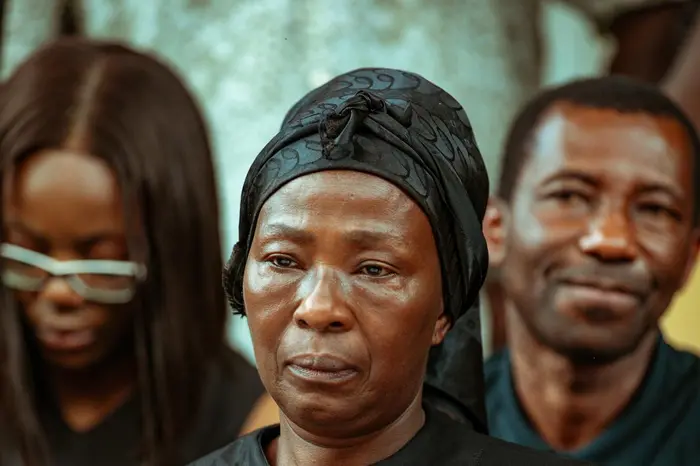
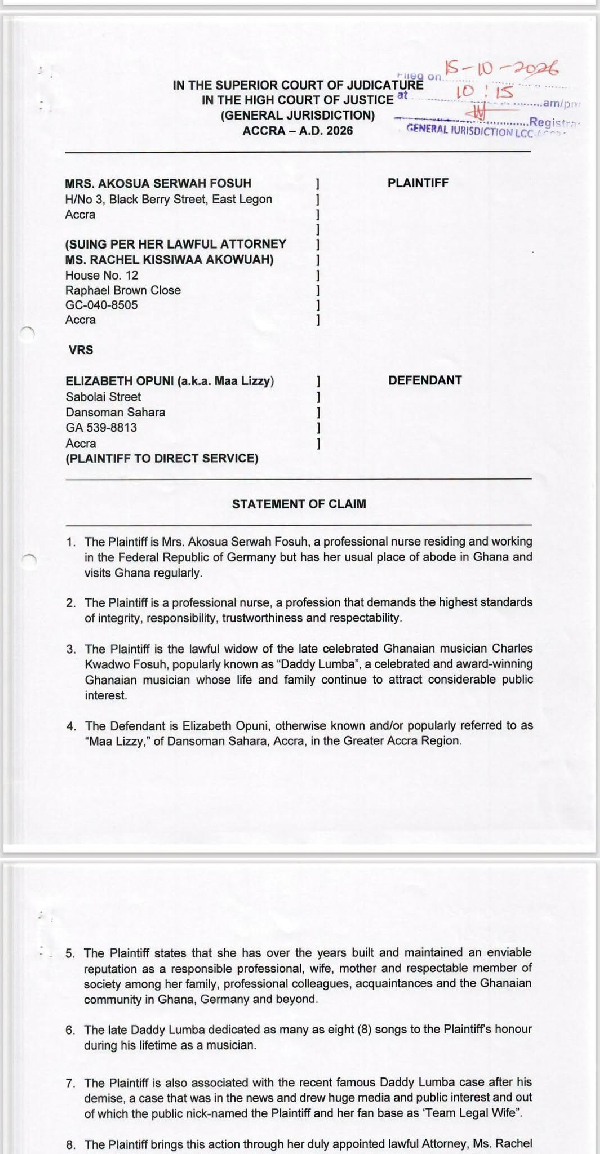
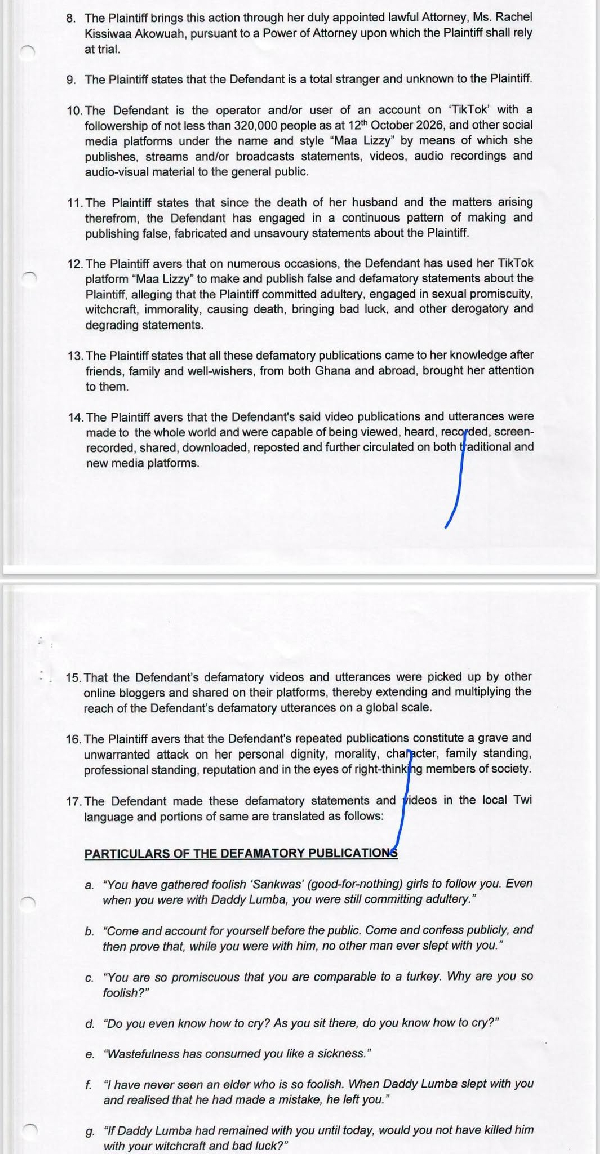
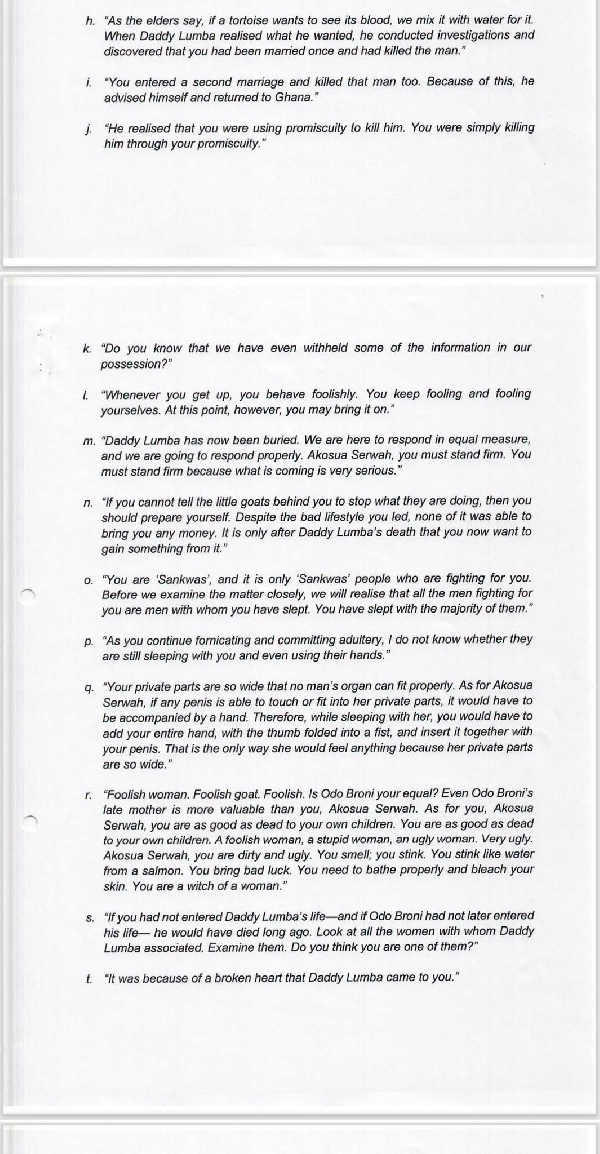
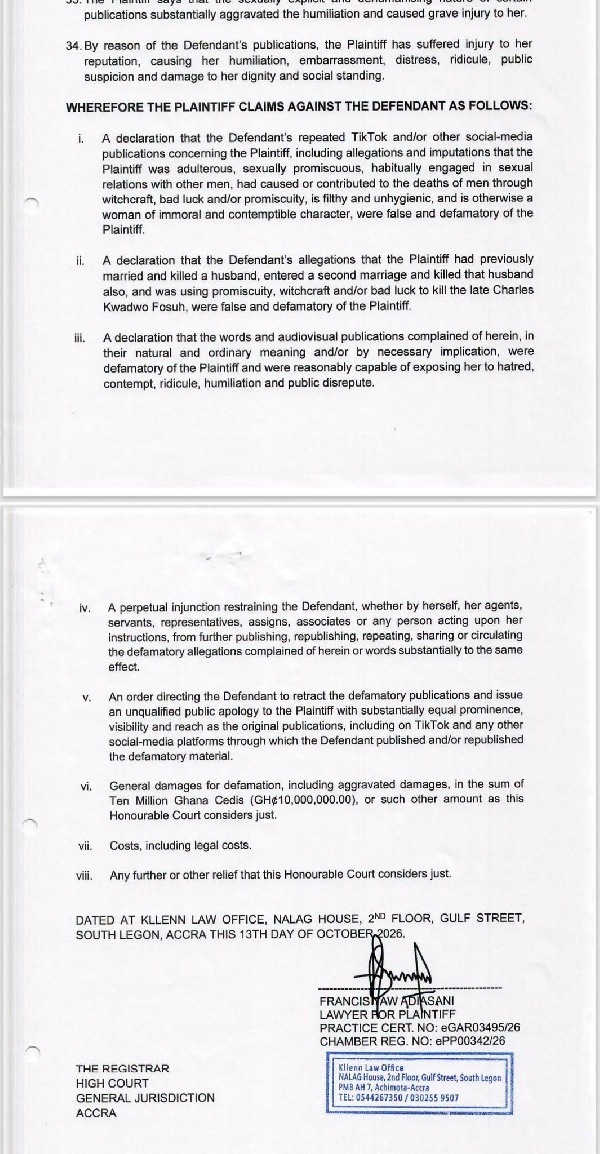
Akosua Serwah Fosu, widow of late Ghanaian highlife legend Daddy Lumba, has dragged TikTok personality Elizabeth Opuni, popularly known as Maa Lizzy, to court, demanding GH¢10 million in damages over alleged defamatory publications.
The professional nurse, who is based in Germany, accuses the social media commentator of making and circulating a series of false and damaging allegations about her following the death of her husband, Charles Kwadwo Fosu.
The suit was filed at the High Court in Accra on October 15, 2026, under suit number GJ/0050/2027.
Court documents indicate that Fosu is pursuing the action through her lawful attorney, Rachel Kissiwaa Akwuah, with legal representation from Kliemn Law Office, led by Francis Yaw Adiasani.
In her statement of claim, the plaintiff maintains that she has established a respectable reputation as a professional, wife, mother and member of society in Ghana, Germany and beyond.
She contends that the publications attributed to Maa Lizzy have injured her dignity, family standing and professional reputation.
Fosu further points out that she has become widely identified as the “Team Legal Wife” amid public discussions and controversies surrounding Daddy Lumba’s death and family.
The defendant is described in the court documents as the operator of a TikTok account bearing the name Maa Lizzy, which allegedly had more than 320,000 followers as of October 12, 2026.
According to the plaintiff, the defendant embarked on a sustained campaign of publishing offensive and fabricated claims about her. She alleges that some of the videos were subsequently shared by other bloggers, extending their reach to audiences in Ghana and abroad.
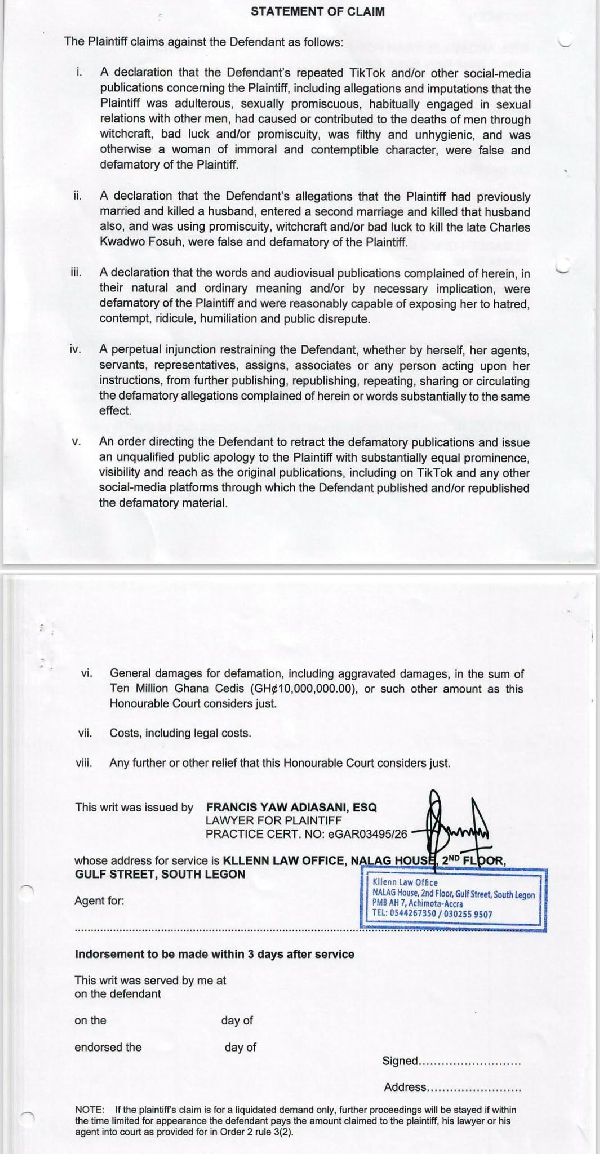
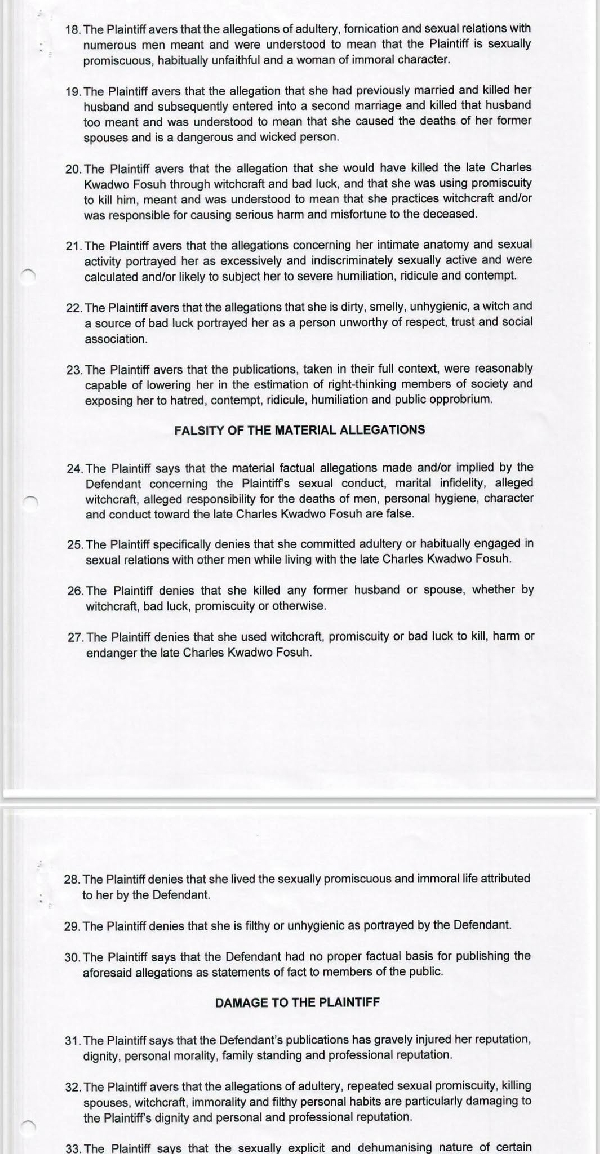
Among the statements outlined in the lawsuit are allegations relating to Fosu’s sexual conduct, personal character and previous relationships.
The court documents also attribute to the defendant claims that the widow was connected to the deaths of previous husbands and that she employed witchcraft and promiscuity against the late musician.
Fosu has denied the allegations, describing them as entirely false and defamatory.
She is asking the court to declare that the publications are defamatory and capable of exposing her to hatred, ridicule, humiliation and public disrepute.
Beyond the GH¢10 million compensation, the widow is seeking a perpetual injunction restraining Maa Lizzy, her agents and assigns from publishing the disputed statements or making further similar allegations against her.
She also wants the court to compel the defendant to retract the publications and issue an unqualified public apology. The apology, she argues, should receive prominence and visibility comparable to the original content published on TikTok and other platforms.
The GH¢10 million claim includes general and aggravated damages, alongside legal costs and any additional relief the court may consider appropriate.
The writ of summons further directs Maa Lizzy to enter an appearance within eight days of being served with the court documents. Failure to comply could allow the court to proceed with the case and enter judgment in her absence.

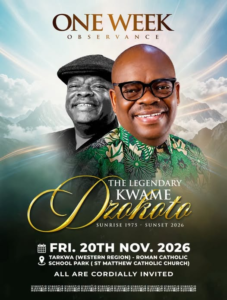
The family of late Ghanaian actor and broadcaster Seth Kwame Dzokoto has announced November 20, 2026, for his one-week observation.
The ceremony, which will take place nearly a month after his death on October 22, will be held at the Roman Catholic School Park, close to St. Matthew Catholic Church in Tarkwa, in the Western Region.
Dzokoto, aged 51, reportedly collapsed after suffering a medical emergency while taking part in a live morning radio discussion on Owass FM in Tarkwa. His sudden passing left many in the entertainment and political circles mourning the loss.
He became a household name through his role as Judge Koboo in the popular television series Efiewura, where his humorous performances and distinctive delivery endeared him to viewers.
He also made significant contributions to broadcasting, notably as the presenter of TV3’s food programme Edziban, which focused on Ghanaian cuisine and promoted the country’s diverse food traditions.
Aside from his work in the media and entertainment industry, Dzokoto ventured into politics, building a public profile that extended beyond the creative arts.
His death sparked an outpouring of tributes from colleagues, fans and well-wishers, many of whom acknowledged his impact on Ghana’s entertainment and broadcasting landscape.
The one-week observation will bring together relatives, friends, colleagues and sympathisers to pay their respects and celebrate the life and legacy of the late entertainer.

Ghanaian broadcaster and political commentator Kwabena Bobie Ansah has publicly apologised to dancehall musician Stonebwoy following comments he made about his preference between the Jejereje hitmaker and his long-time industry rival, Shatta Wale.
In an apology message shared on his official Facebook page, Bobie Ansah expressed regret over his earlier remarks, insisting that he never intended to take a swipe at Stonebwoy or disrespect his contribution to the Ghanaian music industry.
Addressing the musician as bruv, he acknowledged Stonebwoy’s achievements and described him as a legend in his own right, adding that he would not deliberately undermine or disrespect him.
“Hi bruv, I send you my sincere apologies concerning comments I made with respect to my choice between you and Shatta. Respectfully, I did not intend to take a swipe at your person,” he wrote.
Bobie Ansah stressed that his apology was not prompted by insults from Stonebwoy’s fanbase, popularly known as the Bhim Nation, but rather by his desire to address the musician’s displeasure over the comments.
He further referenced his personal experiences confronting a political party and former President Nana Akufo-Addo, claiming that he had endured years of insults, spiritual attacks and even physical threats without backing down.

According to him, his earlier comments were based on what he considered a genuine observation and were not intended to create hostility between the two entertainers.
The broadcaster also disclosed that he rarely listens to Ghanaian music, mentioning Black Sherif and Kofi Kinaata among the few local musicians he regularly listens to. He further made it clear that he is a fan of Black Sherif.
Despite this, Bobie Ansah assured Stonebwoy of his continued support, saying he was ready to support the musician at any time.
He concluded his message by appealing for forgiveness and emphasising the need for unity rather than hostility.
“It takes you and I to make Ghana a better place; practically, we cannot live under the roof of hostility,” he added.

Beyond Free SHS and TVET: Why Parents Are Still Being Asked to Support Schools Through PTA Contributions

NADFFA 2027: Ghana to Host Pan-African Film and Food Festival in March

Before WhatsApp, Ghanaians Wrote Letters: The Beautiful Tradition We Are Slowly Forgetting

IRAWMA 2025: Shatta Wale Wins 3 Major Awards Including Best Music Video

Samini Secures Promotional Deal with Audiomack for Upcoming Album “THE ORIGIN8A”

AirtelTigo losing GH₵20m monthly; total debts exceed $200million – Sam George


-

 General News7 days ago
GTA Staff Demand Answers on World Cup Visa Slots, Staff Dismissals and Unpaid Allowances
-

 Entertainment2 weeks ago
Shatta Wale Cake Tells Story of Growth, Identity and African Dancehall Influence
-

 General News1 week ago
FOKLEX MEDIA AWARDS COMMENDS PRINCE KWAW GYIMAH AND OWASS FM TEAM FOR PROFESSIONALISM DURING KWAME DZOKOTO INCIDENT
-

 General News1 week ago
SAMMY GYAMFI’S “MINE WITHOUT LICENCE” REMARK SPARKS FRESH GALAMSEY DEBATE
-
 General News7 days ago
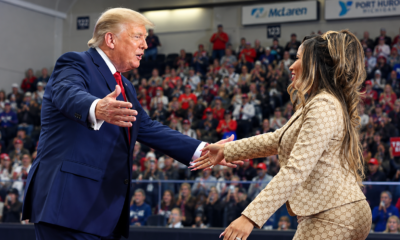
Nicki Minaj Throws Her Support Behind Trump Ahead of US Midterm Elections
-

 Entertainment2 weeks ago
Ghana Unveils December in GH 2026 Calendar With Over 150 Events Nationwide
-

 General News2 weeks ago
PROFOUND GRATITUDE FOR YOUR DECISIVE INTERVENTION IN FAST-TRACKING THE COMPLETION OF THE MUMFORD FISHING HARBOUR
-

 Politics2 weeks ago
OB UASI HEADMASTER IN SEXUAL MISCONDUCT CONTROVERSY EYES NDC CONSTITUENCY CHAIRMANSHIP