General News
Jospong’s AAC Partners Turkish ChitoGlobal to Introduce Shell-Based Crop Treatments in Ghana

The African Agribusiness Consortium Limited (AAC), a subsidiary of the Jospong Group of Companies, has entered into a strategic partnership with Türkiye-based ChitoGlobal Biotechnology to explore innovative agricultural treatments produced from discarded shrimp and crab shells to improve crop production in Ghana.
The partnership, formalised through the signing of a Memorandum of Understanding (MoU) at COP31 in Antalya, Türkiye, seeks to introduce environmentally friendly agricultural solutions that could help Ghanaian farmers improve crop yields, manage plant diseases and reduce their dependence on conventional chemical treatments.
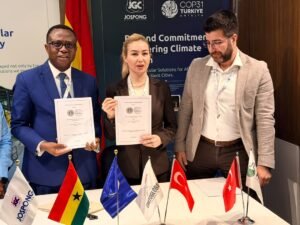

Under the agreement, the two organisations will undertake joint research and field trials in Ghana to determine the effectiveness of chitosan-based agricultural products under local farming conditions.
Chitosan is a natural substance derived from chitin, which is commonly found in the shells of crustaceans such as shrimp and crabs. The material is being explored for its potential to improve agricultural productivity while supporting more sustainable farming practices.
The initial phase of the collaboration will focus on examining how the products can protect seeds and growing plants, strengthen crops against fungal infections and improve their ability to withstand periods of limited rainfall.
Researchers will also assess the potential effects of the treatments on soil quality, crop development and overall yields, particularly in areas where farmers face challenges associated with changing weather conditions and declining soil fertility.
The partnership is expected to explore whether these biological products could provide a more affordable and environmentally sustainable alternative to certain conventional agricultural inputs currently used by farmers.
Speaking after the signing ceremony, the Chief Investment and Innovation Officer of the Jospong Group of Companies, Mr Noah Gyimah, expressed optimism about the collaboration and its potential to transform agricultural practices in Ghana.
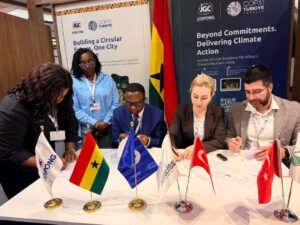

He explained that the Group would engage Ghana’s environmental and standards regulatory authorities to ensure that the proposed products meet the necessary safety and quality requirements before their introduction onto AAC farms.
According to him, the partnership represents an important opportunity to move innovative agricultural technology beyond laboratory research into practical applications that could benefit commercial farmers and smallholder producers.
“Our joint efforts will transition this technology from research and development to practical application. We will commence with collaborative research and field trials in Ghana, followed by technology transfer and full-scale commercial production,” he stated.
Mr Gyimah indicated that the pilot programme would provide an opportunity to determine the commercial viability of the products, assess potential demand within Ghana’s agricultural market and identify prospective buyers.
He further explained that the research would establish whether sufficient raw materials could be sourced locally to support the eventual establishment of production facilities in Ghana.
The Chief Investment and Innovation Officer noted that AAC intends to make the products accessible to smallholder farmers across the country if the research and field trials demonstrate their effectiveness, safety and suitability for Ghanaian agricultural conditions.
Beyond supporting smallholder farmers, he disclosed that the consortium also plans to incorporate the treatments into its large-scale commercial farming operations, particularly in the cultivation of crops and vegetables intended for the Ghanaian market.
The initiative, he explained, forms part of broader efforts to strengthen agricultural productivity, improve food production and explore sustainable technologies capable of supporting Ghana’s growing food requirements.
On her part, the Sales and Technical Support Manager of ChitoGlobal Biotechnology, Dana Abourahma, welcomed the partnership, describing it as an opportunity to combine advanced biotechnology research with practical agricultural experience in Ghana.
“This collaboration brings together extensive local knowledge with cutting-edge scientific capabilities,” she said.
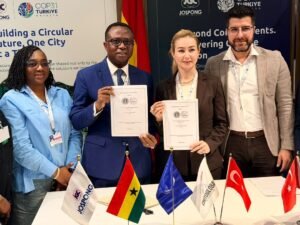

She indicated that the partnership would allow both organisations to draw on their respective strengths in agricultural production, biotechnology and technical research to explore solutions suitable for Ghana’s farming environment.
The agreement followed a working visit by a four-member delegation from AAC to ChitoGlobal Biotechnology’s facility in Antalya, Türkiye.
The delegation was led by AAC’s Coordinator, Dr Emmanuel Volsuuri, who explained that the visit was arranged following his initial engagement with representatives of the Turkish biotechnology company at its pavilion during COP31.
According to Dr Volsuuri, discussions at the pavilion generated interest in the company’s agricultural innovations, prompting further engagements that eventually created an opportunity for the AAC delegation to visit its facility and obtain firsthand information about its operations.
During the visit, the delegation toured the company’s laboratories and other operational facilities to gain a deeper understanding of the composition, development and potential agricultural applications of its biotechnology products.
The team also interacted with technical personnel to learn about the processes involved in developing the chitosan-based treatments and how the technology could potentially be adapted to Ghana’s agricultural conditions.
Dr Volsuuri explained that the visit was particularly important because AAC was interested in identifying innovative methods of managing crop diseases, improving soil health and supporting agricultural production without excessive reliance on conventional chemical treatments.
He expressed concern about the widespread application of certain chemical products in agricultural production, particularly vegetable cultivation, and the potential risks associated with improper or excessive use.
According to him, the increasing dependence on chemical treatments in some farming activities makes it necessary to explore alternative technologies that could help protect crops while promoting safer and more sustainable food production.
He noted that the proposed collaboration would provide an opportunity to investigate whether chitosan-based products could contribute to addressing these concerns through improved plant protection and soil management.
Dr Volsuuri emphasised that the partnership would not only focus on introducing new agricultural products but would also create opportunities for knowledge sharing, scientific research and technology transfer between Ghana and Türkiye.
He explained that the collaboration could eventually support local manufacturing if the trials establish that the products are effective, commercially viable and suitable for Ghanaian farming conditions.
Dr Volsuuri further indicated that AAC, under the leadership of its Chief Executive Officer, Dr Adelaide Araba Siaw Agyepong, is actively involved in commercial agricultural production across Ghana.
The consortium currently cultivates crops including rice, maize, soybeans and vegetables on a commercial scale as part of its efforts to contribute to domestic food production and agricultural development.
In addition to its farming operations, AAC supports farmers through access to agricultural mechanisation services, financing opportunities and markets for their produce.
These interventions are intended to help address some of the major challenges confronting farmers, including limited access to modern farming equipment, inadequate financial resources and difficulties securing reliable markets.
Dr Volsuuri explained that AAC’s involvement in both large-scale farming and smallholder agricultural support makes it a suitable partner for testing and potentially introducing innovative agricultural technologies into Ghana.
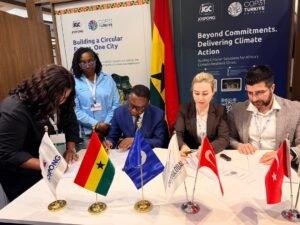
He added that ChitoGlobal Biotechnology’s experience in developing biopolymers for agricultural and medical applications further strengthens the prospects for scientific collaboration between the two organisations.
According to him, combining AAC’s understanding of Ghana’s agricultural environment with ChitoGlobal’s biotechnology expertise could help identify practical solutions to challenges affecting crop productivity and sustainable farming.
The proposed field trials will be essential in determining whether the treatments can deliver measurable improvements in crop performance, soil conditions and disease management before any decision is made regarding commercial production or wider distribution to farmers.