Entertainment
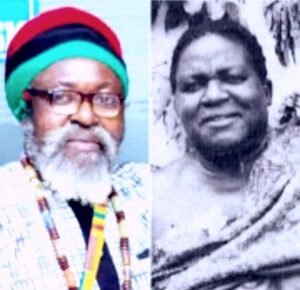
Ras Caleb Appiah-Levi honours late father Cofie Essah Appiah, recounts his life, family and legacy

In a detailed tribute titled “Honouring My Noble Father, Cofie Essah Appiah, a Native of Boso-Gua, and of Blessed Memory,” Ras Caleb reflected on the remarkable life of his father, whose influence extended through his family, professional career, religious activities, political affiliation and investments in farming and property.
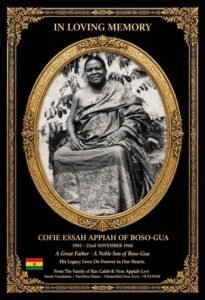

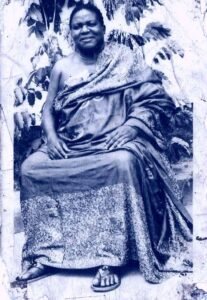
Opanyin Cofie Essah Appiah was born in 1902 to Nenye Kofi Essah of Boso-Gua, near Anum, and Dora Abena Asamaniwaa of Anum, both of blessed memory.
He was the third of three boys born to his parents. However, his two elder brothers died during infancy, leaving him as the only surviving child of his parents.
At a very young age, he was relocated to Suhum, where he began his education at Suhum Anglican School. His time at the school played a significant role in shaping his Christian faith and devotion to the Anglican Church, values he carried throughout his life.
Opanyin Cofie Essah Appiah began his working life with the United Africa Company (U.A.C.) in Suhum before being transferred to Koforidua.
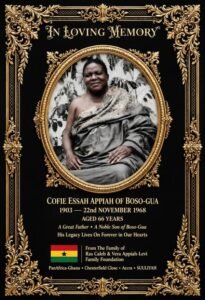

He subsequently joined the Ghana Cocoa Marketing Board (CMB), where his career took him to Akim Oda, serving as a Cocoa Buyer.
Despite his employment, he remained committed to farming and was described by his son as a very industrious and hardworking farmer who invested in agricultural land and property in several communities.
While working in Akim Oda, he acquired farmlands at Akokoaso, where he built a house and named it Boso Villa.
In 1927, at the age of 25, he expanded his investments by acquiring farms and forest lands at various locations, including Adonkwanta, Ateibu, Abobri, Mameneso, Adobenso near Suhum in the Abuakwa District, Nnam, Abirem, Asuom and Ayirebi, in the Akim Kotoku State.
According to Ras Caleb, his father had a habit of building or purchasing houses wherever he went, leaving behind properties in several parts of the country.
These included Akokoaso, Kwae, near the Ghana Oil Palm Development Company Limited, Akim Oda, Koforidua, Accra and Boso, near Anum, opposite the Boso Anglican Church.
His investments in farmlands, forest lands and residential properties reflected his determination to build a lasting economic foundation for himself and his family.
Beyond his professional and business activities, Opanyin Cofie Essah Appiah was a committed Pan-Africanist and staunch member of the Convention People’s Party (CPP), founded by Ghana’s first President, Osagyefo Dr Kwame Nkrumah.
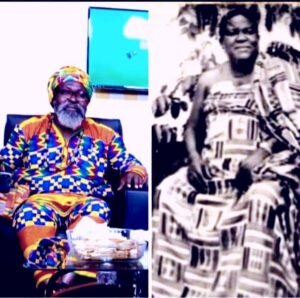

His political beliefs and admiration for the ideals of Dr Nkrumah influenced his son’s early participation in organised youth activities.
Ras Caleb disclosed that his father assisted him, Emmanuel Obiri, to join the Ghana Young Pioneer Movement in 1963.
The Ghana Young Pioneer Movement was a national youth organisation initiated in 1960 and formally established with parliamentary backing in 1961 under Dr Kwame Nkrumah’s leadership.
The organisation was created to instil patriotism, discipline, civic responsibility and national consciousness in young Ghanaians.
Its membership was structured into age groups, including the African Personality grouping for children aged four to eight, Young Pioneers for those aged nine to 16, and Nkrumah Youth for members between 17 and 25 years.
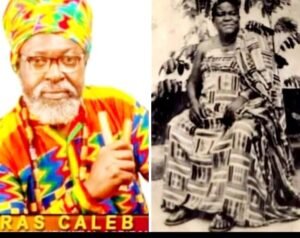

Activities under the movement included classroom instruction, civic and ideological education, physical drills, marching and recreational activities. Members also wore uniforms featuring light-coloured shirts with shoulder patches, dark trousers and neckerchiefs, and participated in daily flag-raising ceremonies.
The movement’s members were guided by a 12-point code of discipline that emphasised love of country, discipline, honesty, punctuality, protection of state property, reliability, secrecy, comradeship, forbearance, love of work, selflessness and the pursuit of faultlessness.
The Ghana Young Pioneer Movement was abolished in 1966 following the overthrow of Dr Nkrumah’s government.
Opanyin Cofie Essah Appiah’s ambition to raise a large family resulted in 17 children, all of whom he reportedly raised under his roof.
His children, as listed by Ras Caleb, are: Dora Asamaniwaa, Janet Ansaah, George Essah, Edward Appiah, popularly known as Lawyer Appiah of Tamale, Adelaide Asamaniwaa, Felix Essah, Ebenezer Asamani, Edith Biamah, Paul Afum, Gifty Okyerebea, Joyce Okyerebea, Rebecca Ansaah, Margaret Latebea, Emmanuel Obiri, also known as Ras Caleb Appiah-Levi, Emmanuel Abrokwa, Joseph Mireku, Benjamin Hadjor

Among his children is Janet Ansaah, who is the biological grandmother of Samuel Kofi Atta Mills, the son of the late former President of Ghana, Prof. John Evans Atta Mills.
Ras Caleb said his father placed enormous importance on education and was determined to provide his children with quality schooling, encouraging them to pursue education to the highest possible level.
His efforts produced children who went on to become lawyers, teachers, engineers, nurses, bankers, traders, farmers and musicians, reflecting the diversity of professional paths taken by his descendants.
Opanyin Cofie Essah Appiah’s faith in Jesus Christ as his personal Saviour and his commitment to the Anglican Church were evident in his contributions to the establishment and development of the church in Boso.
He co-founded the Anglican Church in Boso and made significant contributions to securing a permanent place of worship for the congregation.
Ras Caleb said his father purchased an unfinished structure and donated it to the church to be converted into a church building.

He also donated an organ to the church, which he personally played every Sunday and during other church occasions.
His commitment to the church also influenced his children, with Ras Caleb himself serving as a Mass Server and Bell Boy at the church during his childhood.
The family’s connection to the Anglican Church in Boso remains a significant part of his father’s religious legacy.
Opanyin Cofie Essah Appiah died on November 22, 1968, leaving behind a family whose numbers and achievements have continued to grow over the decades.
According to Ras Caleb, his father is survived by his last eight children, comprising four females and four males, 63 grandchildren, 108 great-grandchildren and seven great-great-grandchildren.

In honouring his father, Ras Caleb reflected on a life that combined professional service, farming, property ownership, political commitment, Christian devotion and the raising of a large family.
His tribute celebrates not only the life of a man born more than a century ago but also the values of hard work, education, faith, discipline, selflessness and family responsibility that he passed on to generations of descendants.