
General News
24-Hour Economy Will Create Jobs, Boost Local Production and Drive Exports – Abdul Nasser Soglu

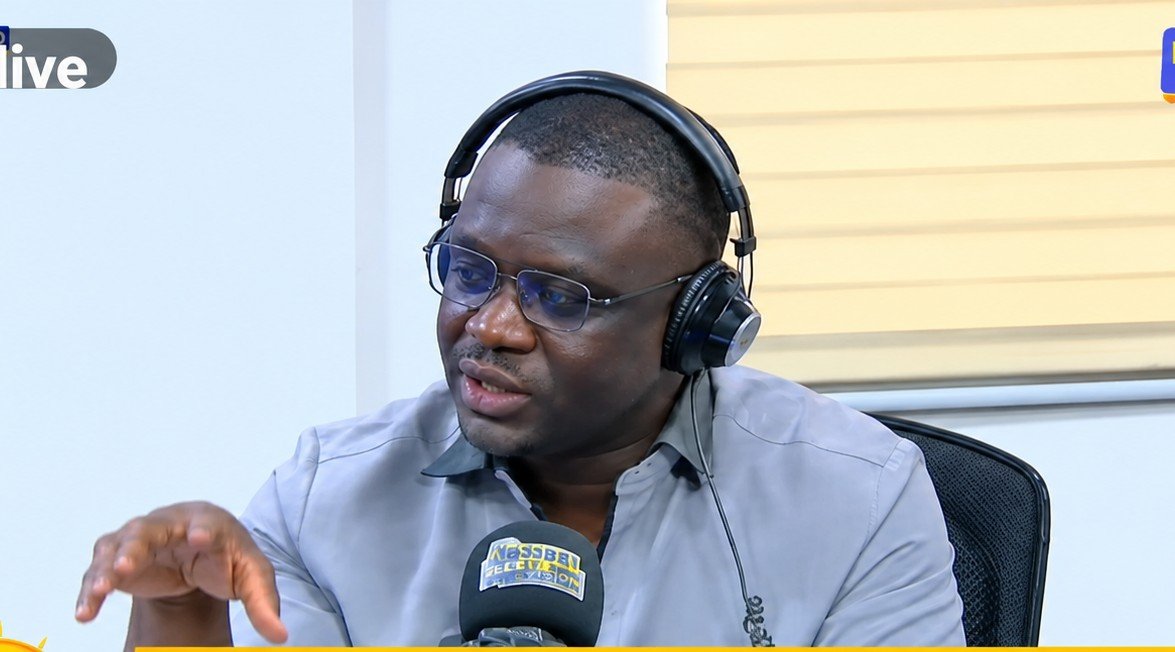
The Chief Programmes Officer of the 24-Hour Economy initiative, Abdul Nasser Soglu Alidu, has described the policy as a major pathway to job creation, industrialisation, increased local production and economic transformation in Ghana.
In an exclusive interview on Kessben Maakye show in Accra, he insisted, the initiative is designed to expand Ghana’s productive capacity, promote exports and generate foreign exchange while strengthening local manufacturing and processing industries.
He explained that the government’s vision goes beyond extending working hours, with a strong focus on building industrial value chains and creating sustainable employment opportunities for Ghanaians.
Highlighting key components of the initiative, including Grow 24, Make 24, Build and Construct 24, Connect 24, Aspire 24 and Show 24, he stressed that the programme seeks to mobilise Ghanaians across various sectors to achieve economic prosperity.
Soglu further explained that the Aspire 24 component focuses on changing the mindset of Ghanaians towards work, productivity and entrepreneurship.
He noted that with a significant proportion of Ghana’s workforce operating in the informal sector, the 24-Hour Economy presents an opportunity to unlock the sector’s potential and accelerate national development.
“The fundamental reason is to create jobs for our local manufacturing and processing sectors,” he stated.
He also emphasised the importance of producing quality and affordable goods locally to encourage domestic consumption, reduce dependence on imports and strengthen Ghanaian businesses.
Responding to concerns about job creation, Soglu maintained that the initiative provides opportunities for businesses to expand their operations, increase production and employ more people.
He further argued that easing inflationary pressures could improve business planning and investment decisions, allowing entrepreneurs to expand their enterprises with greater confidence.
He expressed optimism that the 24-Hour Economy initiative, if fully implemented, could become a major driver of Ghana’s industrial growth, employment creation and long-term economic prosperity.














General News
Radiant Calls for Increased Government Machinery and Massive Capital Spending Ahead of 2027 Budget


Radiant Media and Intelligence Hub have called on the government to increase expenditure on productive government machinery and undertake a major capital investment programme in the 2027 Budget, arguing that Ghana must use its improving economic stability to drive job creation, expand production and prevent economic stagnation.
The proposal, presented by the organisation’s Executive Director, Emmanuel Duah, ahead of the Finance Minister Dr Cassiel Ato Forson’s presentation of the 2027 Budget to Parliament on Thursday, November 12, at 6:00 pm, challenges the conventional approach of reducing government machinery and capital expenditure to control public spending.
According to Radiant, Ghana’s economic recovery has reached a stage where the priority should no longer be limited to stabilising the economy but should focus on converting the gains into productive investments that directly benefit businesses, farmers and ordinary citizens.
In its 2027 Budget preview, titled “Why Radiant Proposes Increase in Government Machinery Expenditure and Huge Capital Build to Lock in Micro-Stability,” the organisation argued that the country must make deliberate investment decisions to protect the progress made in recent years.
Radiant pointed to improvements in several economic indicators as evidence that Ghana is gradually recovering from its recent economic difficulties.
Inflation, which stood at 54.1 per cent in December 2022, declined to 23.8 per cent in December 2024 and further to 5.4 per cent in December 2025.
It subsequently dropped to 5.2 per cent in September 2026 before rising slightly to 5.5 per cent in October 2026, remaining within the Bank of Ghana’s medium-term inflation target range of 6 to 10 per cent.
The organisation also highlighted Ghana’s economic growth performance, noting that the economy expanded by six per cent in 2025 and recorded six per cent growth in the second quarter of 2026.
The Composite Index of Economic Activity also recorded a 14.9 per cent increase in July 2026.
On the international financial front, Ghana completed its US$3 billion International Monetary Fund Extended Credit Facility programme in July 2026, receiving the final tranche of US$371 million.
The country has since moved to a 36-month non-financing Policy Coordination Instrument with the IMF.
Radiant further noted that the cedi recorded a 40.7 per cent appreciation in 2025, while its depreciation in 2026 has been estimated at between 9.5 and 11 per cent, with the currency trading at approximately GH¢11.55 to the US dollar.
The country’s international reserves were also estimated at US$12 billion, representing approximately four months of import cover.
On fiscal performance, the organisation cited a primary surplus of 1.4 per cent of GDP between January and July 2026, while the fiscal deficit stood at 0.2 per cent against a target of 1.9 per cent.
However, it attributed part of the improved fiscal position to expenditure remaining below planned levels.
Radiant cautioned that the current stability, supported by tight monetary policy, the Gold-for-Reserves programme and expenditure controls, could remain fragile if it is not accompanied by investments that expand the country’s productive capacity.
It noted that with the monetary policy rate still at 14 per cent, Ghana must move beyond simply holding its economic position.
The organisation referenced observations by SIC Brokerage that the country had “held ground, not gained new ground”, arguing that the 2027 Budget must address this gap.
A major concern raised by Radiant is the approaching repayment obligations associated with the Domestic Debt Exchange Programme (DDEP).
The organisation estimates that Ghana faces GH¢58.4 billion in DDEP repayments in 2027, comprising GH¢39.6 billion in principal and GH¢18.8 billion in interest.
This will be followed by another GH¢53 billion in 2028, bringing the combined repayment obligations for the two years to approximately GH¢111 billion.
Radiant warned that responding to these obligations by continuously reducing government machinery and capital expenditure could undermine economic growth.
It argued that Ghana risks stabilising the economy at the expense of development if resources are not allocated to investments capable of generating returns, creating employment and strengthening domestic production.
Consequently, it has proposed a four-pillar approach to the 2027 Budget.
Increase government machinery expenditure through productive investments
Radiant is advocating a strategic increase in government machinery expenditure, proposing a 30 per cent increase targeted at essential equipment and operational infrastructure.
The organisation stressed that the proposal is not intended to finance luxury vehicles or unnecessary government spending but to provide public institutions with the equipment needed to perform their duties effectively.
Among its recommendations are increased investment in Motor Traffic and Transport Department (MTTD) back-office operations to support the implementation of TraffiTech-GH.
It also wants the Ghana Meteorological Agency (GMet) to receive additional equipment to strengthen early-warning systems, particularly in preparation for the anticipated strong El Niño conditions between November 2026 and January 2027.
Radiant cited a 96 per cent probability of a very strong El Niño during the period, stressing the need for improved weather monitoring and preparedness.
Other proposed investments include modern audit equipment for the Ghana Revenue Authority (GRA) to improve monitoring of gold exports and reduce revenue leakages.
The organisation is also calling for increased investment in irrigation machinery, tractors, harvesters and water pumps to support agricultural production, particularly in northern Ghana and transition zones.
It further referenced the IMF’s Article IV assessment, which indicates that achieving the Sustainable Development Goals will require additional spending equivalent to 16 per cent of GDP by 2030.
According to Radiant, such ambitions cannot be achieved without properly equipped institutions and functional machinery.
Massive capital investment under the US$10 billion New Economy Programme
The second pillar focuses on what Radiant describes as a huge capital build, particularly through the proposed US$10 billion New Economy Programme covering 2027 to 2030.
The programme, expected to be unveiled by the Finance Minister, is built around seven pillars and is intended to focus on job creation, improved farmer incomes and increased local processing.
Radiant is urging the government to ring-fence funding for the programme to ensure that the resources allocated are used for their intended development objectives.
Among the priority projects identified is the proposed Accra-Kumasi Expressway, which is expected to begin in January 2027.
It has also highlighted the 27-kilometre Mpakadan-Boankra railway link under the Eastern Railway development project, as well as irrigation investments at Kpong Left Bank and Pwalugu.
The organisation further wants the GH¢1 billion Housing Fund directed by President John Dramani Mahama to be linked to local manufacturing.
It argued that the housing initiative should create demand for locally produced cement, iron rods and other construction materials rather than rely heavily on imported products.
Radiant also wants the pharmaceutical and agribusiness sectors to receive significant attention in the budget.
It referenced the US$2 billion investment pledge being demanded by the Association of Ghana Industries (AGI), insisting that such commitments must translate into actual factory working capital and productive investments rather than spending on conferences and related activities.
Financing capital projects without undermining economic stability
The third proposal focuses on how the government can finance major capital projects without creating fresh economic pressures.
Radiant is recommending what it describes as a Sinking Fund model, drawing inspiration from the country’s existing approach to building reserves for debt repayment.
It noted that as of July 22, 2026, the Sinking Fund held GH¢15.6 billion, with a target of GH¢30 billion by December 2026.
The fund’s accumulation strategy involves setting aside seven per cent of non-oil tax revenue monthly.
Radiant wants a similar disciplined approach to be adopted for financing selected development projects.
It is proposing that seven per cent of TraffiTech fines and gold royalties be channelled into a dedicated Safety and Irrigation Fund instead of being paid into the Consolidated Fund.
The organisation also recommends a hedging approach to the country’s GoldBod reserves.
Under the proposal, when gold prices reach US$4,500 per ounce, the government should save part of the proceeds.
Similarly, when Brent crude oil prices reach US$100 per barrel, resources should be released to support irrigation investments rather than consumption-related expenditure.
According to Radiant, this approach would help create a sustainable funding mechanism for development projects while protecting the country’s broader economic stability.
Turning economic stabilisation into jobs and improved living conditions
The fourth pillar focuses on ensuring that the benefits of economic recovery reach ordinary Ghanaians.
Radiant identified youth unemployment, estimated at 30 per cent in its assessment, as one of the major challenges the 2027 Budget must address.
It also expressed concern that although headline inflation has declined, services inflation remains at 9.4 per cent, with transportation fares, rent and food prices, particularly tomatoes, continuing to place pressure on households.
The organisation cited concerns among traders in Cape Coast, who argue that the positive economic growth figures are not yet translating into improved business conditions and stronger sales at the market level.
To address these concerns, Radiant wants the government to provide measurable targets showing how much employment the proposed US$10 billion New Economy Programme will generate.
It has proposed a target of 100,000 jobs annually and wants the budget to demonstrate how much employment can be created for every US$1 billion invested.
It also wants the government to explain how agricultural investments, particularly irrigation projects, will improve farmers’ incomes and reduce the cost of food.
Radiant believes improved irrigation infrastructure could help increase tomato production, reduce seasonal shortages and bring down prices.
It further argues that addressing the cost of essential services, including transportation and housing, must form part of efforts to make economic recovery meaningful to households.
The organisation’s proposals come amid calls for greater transparency regarding the financing of the proposed US$10 billion New Economy Programme.
It referenced concerns raised by the Minority’s Finance spokesperson, Dr Mohammed Amin Adam, who has demanded clarity on how the programme will be financed.
Radiant believes the Finance Minister must use the November 12 presentation to Parliament to explain how much of the proposed funding will come directly from the national budget, public-private partnerships (PPPs) and borrowing.
It insists that the programme must be supported by a clear, costed financing plan, with defined targets and accountability measures.
The organisation maintains that Ghana’s improving economic indicators provide an opportunity to move from stabilisation to sustainable development.
It is therefore urging the government to use the 2027 Budget to invest strategically in productive government machinery, major infrastructure, agriculture, local manufacturing and job creation.
For Radiant, the central test of the November 12 Budget will not simply be whether Ghana can maintain lower inflation and fiscal discipline, but whether the economic gains can translate into jobs, stronger businesses, improved farmer incomes and a better standard of living for citizens.

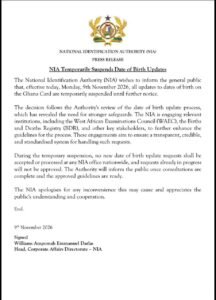
The National Identification Authority (NIA) has announced the suspension of all requests for date of birth changes on the Ghana Card until further notice.
In a statement issued on November 9, the Authority announced that the suspension will remain in force until further notice as it reviews and strengthens the procedures governing date of birth amendments.
According to the NIA, an internal review of its existing date of birth update process revealed the need to introduce stronger safeguards to ensure such requests are handled more effectively.
The Authority disclosed that it is engaging relevant institutions, including the West African Examinations Council (WAEC), the Births and Deaths Registry (BDR), and other key stakeholders, to develop stronger guidelines for processing date of birth changes.
The consultations are expected to establish a more transparent, credible and standardised system for handling applications involving amendments to dates of birth on the Ghana Card.
The NIA further clarified that no new applications for date of birth changes will be accepted or processed at any of its offices nationwide during the suspension period.
It added that applications already submitted and undergoing processing will also not be approved until further notice.
The Authority assured the public that it will communicate further once consultations have been completed and the revised guidelines are ready for implementation.
Meanwhile, the NIA has apologised for any inconvenience the temporary suspension may cause and appealed for the public’s understanding and cooperation.
The statement was signed by Williams Ampomah Emmanuel Darlas, Head of the Corporate Affairs Directorate of the National Identification Authority, and dated November 9, 2026.
In an industry where some voices are heard every morning, familiar faces appear on television screens, and certain journalists command large audiences, it is easy to associate visibility with excellence. But when the conversation turns to who deserves to be called Journalist of the Year, an important question emerges: what exactly are we measuring?
Is it the number of people who listen to a journalist? The popularity of their programme? Their ability to hold conversations, interview public figures and command attention in the studio? Or should the recognition go beyond these visible achievements?
Journalism is more than being behind a microphone or in front of a camera. It is a profession built on the responsibility to inform, investigate, question, verify and hold power accountable. While broadcasting provides an important platform for these responsibilities, occupying that platform does not automatically establish professional excellence.
A journalist’s contribution should be reflected in the quality of their work. Accuracy, originality, depth of research, fairness, ethical conduct and public impact are essential considerations. The ability to uncover stories that would otherwise remain untold, challenge misinformation, question institutional failures and give attention to overlooked communities is equally significant.
This does not diminish the work of broadcasters. A presenter who consistently asks difficult questions, challenges public officials, investigates public concerns and promotes meaningful discussions is making a valuable journalistic contribution. In fact, some of the most consequential journalism takes place through radio and television programmes.
However, popularity should not become the ultimate measure of professional achievement. A journalist may have an impressive audience and considerable public influence, but the more important question is what that influence achieves. Does it improve public understanding? Does it encourage accountability? Does it bring important issues to light? Does it provide information that people can trust?
There are also journalists whose work rarely attracts public applause. They spend time in communities, pursue difficult investigations, verify information and report stories that may never generate trending conversations. Their contributions may be less visible, but their work remains essential to the profession.
Ultimately, being Journalist of the Year should not simply be about who is the most recognised personality in the media. It should be about who demonstrates an exceptional commitment to the principles and responsibilities of journalism.
Perhaps the better question is not who speaks to the largest audience, but who uses their platform, skills and professional responsibility to make the greatest contribution to society.
Because journalism should not be measured merely by how many people hear your voice, but by the value of what that voice brings to the public.
Source: Benedicta Yaa Ohenewaa Asamoah
General News
Importers and Exporters Association of Ghana Partners ICSG to Strengthen Cargo Insurance Claims Support

The Importers and Exporters Association of Ghana (IEAG) has partnered with Insurance Claims Specialist Group (ICSG) Limited to strengthen cargo loss assessment and insurance claims management services for businesses as Ghana prepares to enforce its compulsory local marine cargo insurance framework.
The partnership is aimed at helping importers and exporters recover losses arising from damaged or missing consignments by providing specialised technical support throughout the insurance claims process.
According to IEAG, having insurance cover alone does not guarantee adequate protection for businesses, as many traders lack the expertise required to properly document cargo losses, assess damages and pursue compensation from insurance providers.
Executive Secretary of IEAG, Samson Asaki Awingobit, said the collaboration would address this challenge by helping businesses understand and navigate the claims process more effectively.
“Securing insurance cover is only one part of effective risk management. Knowing how to properly document, assess and pursue claims when losses occur is equally important,” he said.
Mr Awingobit noted that the availability of reliable local claims assessment services would be critical to building confidence in Ghana’s marine cargo insurance system, particularly as more insurance transactions are handled within the country.
Chief Executive Officer of ICSG, Dennis Tufour, also stressed the importance of effective cargo loss assessment, explaining that losses involving imported goods could have wider consequences beyond the financial value of the consignments.
He said such losses could affect business capital, contractual obligations, employment and the ability of companies to maintain their operations.
“Marine cargo insurance is not merely paperwork at the port. It is protection for capital, contracts, jobs and business continuity,” he stated.
Under the agreement, ICSG will provide professional cargo inspection and loss assessment services, including examining damaged consignments, determining the probable causes and extent of losses, gathering supporting evidence and preparing assessment reports to support insurance claims.
The partnership will also introduce a public education campaign using radio, television, print and digital platforms to improve awareness of marine cargo insurance and claims management.
The campaign will cover insurance requirements, policy conditions, claims procedures, timely reporting of losses and preventive measures businesses can adopt to minimise cargo damage.
Small and medium-sized enterprises (SMEs) will receive particular attention because of their limited financial capacity to absorb substantial losses resulting from damaged or missing goods.
Mr Tufour has consequently encouraged businesses to adopt three important practices when dealing with cargo insurance: “Insure correctly. Report promptly. Document professionally.”
The partnership comes as Ghana moves towards strengthening its local marine cargo insurance framework, with effective loss assessment and claims management expected to be important in ensuring that importers and exporters receive the protection and compensation they need when cargo losses occur.
Source: Citi Newsroom

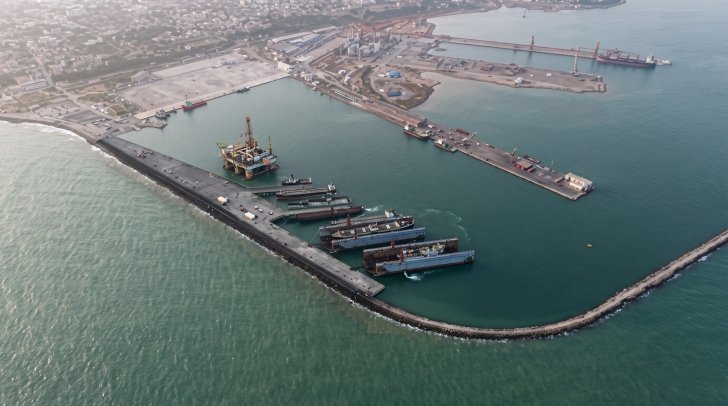
Ghana’s maritime industry is set for a major boost as construction begins on a US$137 million integrated ship repair and maintenance facility at the Takoradi Port in the Western Region.
Known as Project Shiprite, the facility is expected to position Ghana as a major maritime services hub in the Gulf of Guinea while creating up to 430 direct employment opportunities.
The project, being developed by Prime Meridian Docks (PMD) Ghana Limited in partnership with the Ghana Ports and Harbours Authority (GPHA), is scheduled to break ground on Tuesday, November 10, 2026.
President John Dramani Mahama is expected to attend the ceremony alongside the Transport Minister, industry stakeholders, investors and other project partners.
Facility to handle vessels up to 200 metres
When completed, Project Shiprite will provide modern commercial ship repair and dry-docking services for vessels measuring up to 200 metres in length.
The development is expected to address a major gap in maritime infrastructure across the Gulf of Guinea, where vessels currently travel long distances to access specialised ship repair facilities.
Ships operating in the region often have to sail for between 10 and 14 days to facilities in Walvis Bay, Namibia, or Las Palmas, Spain, for mandatory dry-docking and other maintenance services.
The Takoradi facility is expected to reduce these long journeys, lower operational costs, minimise vessel downtime and cut fuel consumption and emissions.
430 direct jobs expected
Beyond strengthening Ghana’s maritime infrastructure, the project is expected to create up to 430 direct jobs and provide business opportunities for local suppliers, contractors and service providers.
It will also support technical training and professional development, particularly for Ghanaian workers seeking opportunities in the maritime engineering and ship maintenance sectors.
As part of efforts to promote women’s participation in the industry, Project Shiprite will receive a US$300,000 grant from the Private Infrastructure Development Group (PIDG) to implement a 24-month Gender Impact Enhancement Programme.
The initiative will provide skills development, professional certification and practical industry exposure to women seeking careers in the facility’s technical workforce.
Ghanaian and international investors support project
The US$137 million investment is being financed through a partnership involving local and international investors, development finance institutions and private-sector partners.
Prime Meridian Docks Ghana Limited is developing the project under a 25-year concession agreement with the Ghana Ports and Harbours Authority.
The financing consortium includes PIDG, ARM-Harith Infrastructure Fund, African Export-Import Bank, African Development Bank, Trade and Development Bank, Petra Pension Schemes and Origen Private Debt Fund.
The project’s financial close was achieved in 2026, clearing the way for construction to commence.
Government targets regional maritime hub status
The development forms part of Ghana’s broader ambition to expand its maritime infrastructure, attract international investment and strengthen its position in regional shipping and logistics.
Director-General of the Ghana Ports and Harbours Authority, Major General Paul Seidu Tanye-Kulono, said Project Shiprite advances the authority’s objective of opening Ghana’s maritime market to ship repair and maintenance businesses.
He expressed confidence that the facility would help establish Takoradi Port as a leading destination for ship repair and related services in the region.
Chief Executive Officer of Prime Meridian Docks Ghana Limited, Stanley Ahorlu, also said the company was focused on delivering a reliable ship repair facility, developing local technical skills and creating opportunities for Ghanaian businesses.
The project was previously highlighted as a flagship investment under the UK-Ghana Growth Partnership signed in London in June 2026.
When completed, Project Shiprite is expected to reduce the need for vessels operating in the Gulf of Guinea to seek maintenance services outside the region, retain more foreign exchange within Africa and strengthen Ghana’s maritime economy.

Shea Butter: The Golden Treasure from Northern Ghana Taking the World by Storm

I’ve Never Liked Democracy’ – George Quaye’s Take on Ghana’s Governance

Diana Hamilton Warns Gospel Artistes Against Narrow Definition Of Breakthrough

IRAWMA 2025: Shatta Wale Wins 3 Major Awards Including Best Music Video

AirtelTigo losing GH₵20m monthly; total debts exceed $200million – Sam George

Samini Secures Promotional Deal with Audiomack for Upcoming Album “THE ORIGIN8A”


-
 Culture2 hours ago
Shea Butter: The Golden Treasure from Northern Ghana Taking the World by Storm
-

 Entertainment12 hours ago
Samini Denies Reports of Interest in NPP Parliamentary Primaries
-

 Politics12 hours ago
Edward Agyekum Kufuor Declares Intention to Contest NPP Parliamentary Primaries in Atwima Nwabiagya North
-

 Culture10 hours ago
Beyond the Flag: The Powerful Symbols That Tell Ghana’s Story of Freedom, Unity and Heritage
-

 Entertainment10 hours ago
Agya Koo Hopes to Finally Work with Shirley Frimpong-Manso
-

 Entertainment9 hours ago
I Guess I Lied – Efya Reacts After Old Video of Her Rejecting Marriage Resurfaces Following Wedding
-

 General News5 hours ago
Radiant Calls for Increased Government Machinery and Massive Capital Spending Ahead of 2027 Budget
-

 Entertainment4 hours ago
I Cry for Christianity in Ghana – Nigel Gaisie Warns Young Pastors Lack Passion for Ministry