
General News
Kade Rape and Robbery Suspect Linked to 7 Attacks, Murder Dies During Police Operation


A 39-year-old ex-convict suspected of terrorising women with a series of rape and robbery attacks in Kade and surrounding communities has died after sustaining gunshot wounds during a police operation.
The suspect, identified as Kwaku Asomani, was reportedly linked to seven separate incidents of robbery and rape involving female victims between February 19 and November 10, 2026, in the Kwaebibirem District of the Eastern Region.
According to the Eastern South Regional Police Command, the suspect allegedly targeted women aged between 18 and 54, robbing them of cash and personal belongings before sexually assaulting them.
The police further linked Asomani to the death of 28-year-old Esther Opoku, whose body was discovered on October 1, 2026, opposite Hotel De Nyarko in the Guggisberg area of Kade.
The alleged crimes triggered investigations by the Anti-Armed Robbery Unit of the Criminal Investigations Department (CID) Headquarters, working in collaboration with personnel from the Kade District Command.
Following what police described as intensive surveillance operations, investigators reportedly tracked down the suspect on November 14, 2026, at Assemblies of God in Kade.
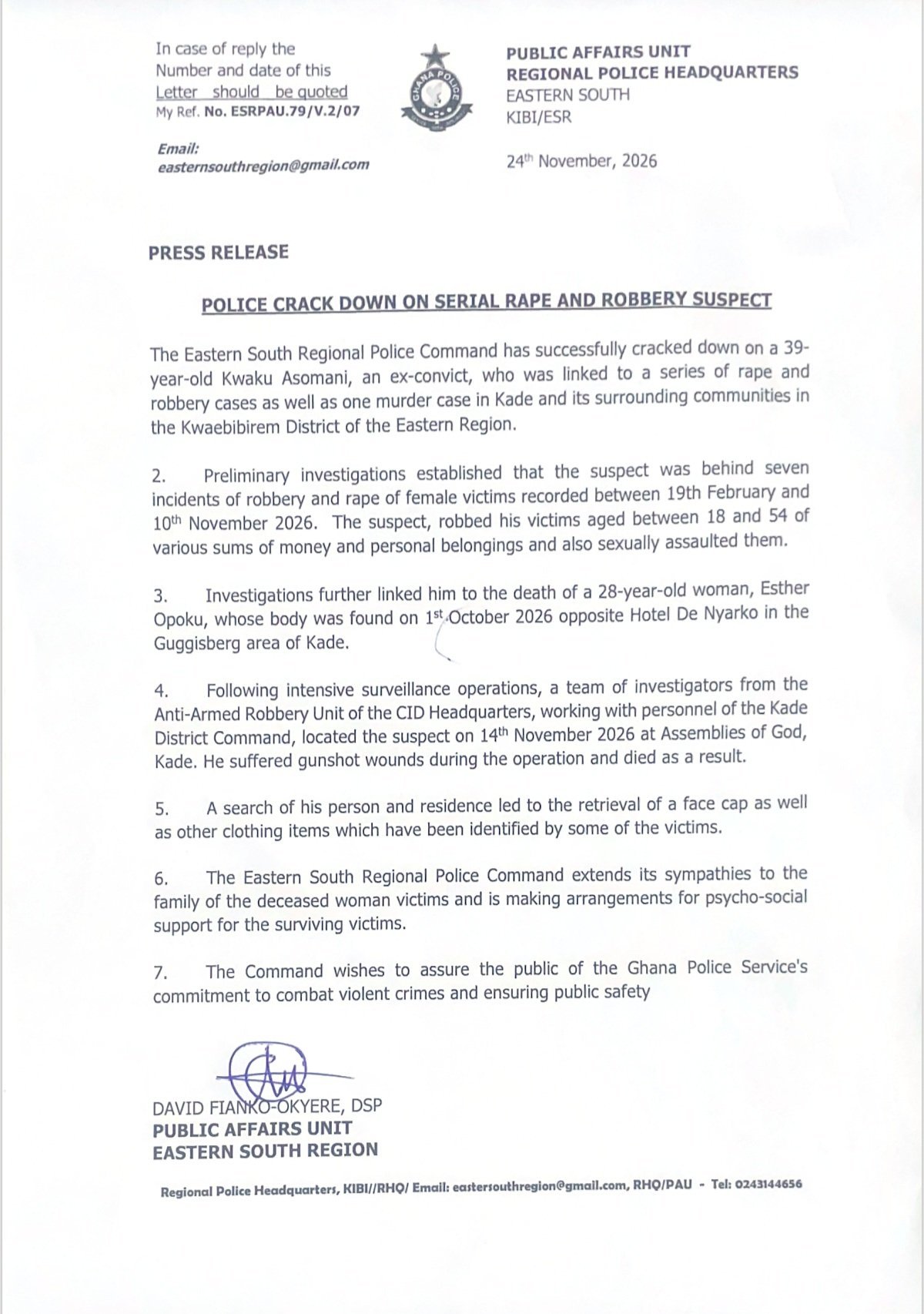
The operation, however, ended with Asomani sustaining gunshot wounds. He subsequently died from his injuries, according to the police statement.
Items recovered during operation
Police said a search conducted on the suspect and his residence led to the retrieval of a face cap and other clothing items believed to be connected to the alleged criminal activities.
Some of the victims have reportedly identified the recovered items, which investigators believe could assist in establishing further details surrounding the incidents.
The police have not disclosed additional details about the circumstances surrounding the shooting during the operation.
Police offer support to victims
The Eastern South Regional Police Command has expressed sympathy to the families of the deceased victims, particularly the family of Esther Opoku, whose death has been linked to the suspect.
The Command also disclosed that arrangements were being made to provide psychosocial support to surviving victims of the alleged rape attacks, acknowledging the trauma associated with the incidents.
The case has renewed concerns about violent crimes against women and the safety of residents in Kade and neighbouring communities.
The Police Command has assured the public of its commitment to fighting violent crime and protecting lives and property, urging residents to remain vigilant and cooperate with law enforcement agencies.
With the suspect now dead, police investigations into the reported incidents and the murder of Esther Opoku remain a major concern for affected families and residents seeking answers and justice.

















General News
Don’t Ban the Child, Fine the Parent – Seth Dankwah Challenges GES Two-Year Examination Ban


In an article dated Wednesday, November 25, 2026, titled “Don’t Ban the Child! Fine the Parent,” the writer argued that sanctions should target parents, headteachers, school proprietors and other individuals responsible for the premature registration of candidates rather than children who have little or no control over such decisions.
His concerns follow an announcement by the Minister for Education, Haruna Iddrisu, on November 23, 2026, during the launch of the 2026 National Education Week at the Ghana Tertiary Education Commission (GTEC).
According to the writer, the GES subsequently issued a directive with reference number GES/HQ/DG/746/2026, signed by its Director-General, Prof. Ernest Kofi Davis, instructing all Regional Directors of Education to strictly enforce the policy.
Under the directive, candidates who sit for BECE or WASSCE ahead of their officially scheduled examination period will be barred from taking the relevant examination for two years.
Dankwah acknowledged that premature examination registration has become a worrying practice within Ghana’s educational system, particularly among schools that register JHS 2 pupils for BECE and SHS 2 students for WASSCE.
Citing figures attributed to the West African Examinations Council (WAEC), he indicated that approximately 5,000 candidates are prematurely registered for BECE annually.
He explained that the practice undermines examination integrity, distorts enrolment and placement data, increases examination expenditure and creates unfair competition among educational institutions.
However, he maintained that although the GES is justified in addressing the irregularity, its approach to punishment is misplaced.
“Where the policy fails is not in its intention. It fails in its target, in its proportionality, and in its failure to make room for the exceptional child,” he stated.
The writer questioned why children should bear the consequences of decisions largely made by adults.
He explained that pupils aged 13 or 14 do not independently complete WAEC registration forms, prepare Continuous Assessment records, pay registration fees or determine when they should sit for external examinations.
According to him, such decisions are often influenced by parents seeking early academic progression for their children, headteachers seeking recognition and school proprietors attempting to attract enrolment through impressive academic achievements.
He added that some parents may also seek early examination registration to reduce the financial burden of keeping their children in school for an additional year.
“The child is only told: ‘You are writing this year.’ In many cases, the child is not even told that what is happening is irregular and against the law,” he noted.
Dankwah argued that punishing children under such circumstances amounts to holding them responsible for decisions they had no authority to make.
The writer further expressed concern about the potential social, psychological and educational consequences of the sanction.
He explained that affected students could experience emotional distress, loss of confidence, academic setbacks and difficulty reintegrating into the educational system.
He warned that children from economically disadvantaged households could be particularly vulnerable, as some parents may struggle to support them throughout the period of the ban.
According to him, prolonged interruption of education could expose some children to teenage pregnancy, early marriage, child labour, illegal mining, street life and permanent school dropout.
“No examination irregularity by an adult should cost a child two years of his education,” he stressed.
Drawing on a legal illustration by education advocate Kofi Asare, Dankwah argued that Ghana already has legal provisions under which adults involved in fraudulent examination registration could be sanctioned.
He cited a hypothetical situation in which a parent approaches a headteacher to register an academically gifted JHS 2 pupil for BECE, resulting in the fabrication of mandatory JHS 3 Continuous Assessment records.
According to the legal illustration referenced in his article, a headteacher involved in such conduct could face potential prosecution under Sections 249 and 250 of the Criminal Offences Act, 1960 (Act 29), as amended by Act 1034, relating to false certification and falsification of official documents.
He stated that the offences could attract prison sentences of between five and ten years upon conviction.
He also referenced Section 4(g) of the WAEC Act, 2006 (Act 719), which he said provides sanctions for falsification of examination records, including imprisonment of up to two years, a fine or both.
Additionally, Dankwah cited Sections 3.36(iii) and 3.36(iv) of the 2017 GES Code of Conduct for Staff, arguing that headteachers involved in dishonest conduct could face disciplinary action, including dismissal.
Parents who knowingly encourage or facilitate the fabrication of examination records, he added, could potentially face prosecution for abetment under Section 20 of Act 29.
Regarding students, he referenced Rule 10(3) of WAEC’s 2023 regulations on examination irregularities, which he said provides for the cancellation of examination results where candidates are found culpable following investigations.
He questioned why an administrative directive should impose an additional two-year ban on children when existing provisions already allow for the cancellation of irregular examination results and sanctions against responsible adults.
As an alternative to the two-year ban, Dankwah proposed financial, administrative and disciplinary measures against individuals and institutions responsible for premature examination registration.
He recommended that parents who knowingly pressure schools into registering ineligible candidates should be made to pay the full cost of the examination alongside an administrative penalty, subject to the necessary legal framework.
He stressed that penalties should distinguish between parents who deliberately facilitate irregularities and those who are misled by educational institutions.
He further proposed the following measures:
-
Suspension or withdrawal of the examination registration status of offending schools.
-
Disciplinary action against headteachers, including queries, demotion, interdiction or dismissal where appropriate.
-
Financial penalties against school proprietors and institutions involved in premature registration.
-
Cancellation of irregular examination results without preventing affected students from writing at the appropriate time.
-
Publication of the names of offending schools following investigations.
-
Recovery of public funds spent on registering ineligible candidates from responsible adults and institutions.
According to Dankwah, these measures would discourage examination irregularities while protecting children’s academic progression.
The writer also cited the academic journey of renowned Ghanaian lawyer Tsatsu Tsikata to demonstrate the importance of creating opportunities for exceptionally gifted students.
He recalled how Tsikata began schooling at an early age and was promoted from Year Two to Year Three at Accra Newtown Experimental School after his teachers recognised his exceptional academic abilities.
According to Dankwah, Tsikata subsequently secured a United Africa Company (UAC) scholarship in 1960 and entered Mfantsipim School at the age of nine.
He later gained admission to the University of Ghana at 16, obtained a First-Class Bachelor of Laws degree at 18 and continued his academic journey at Oxford University.
Dankwah argued that Tsikata’s achievements illustrate the importance of allowing educational systems to accommodate gifted learners through legitimate academic acceleration.
“He was not a cheat. He was not a product of a school trying to game the system. He was an exceptional child whose teachers recognised his ability and allowed the system to bend for him,” he stated.
He expressed concern that a blanket examination ban without clearly defined exceptions could prevent Ghana from identifying and nurturing exceptionally talented children.
Dankwah proposed the establishment of a formal Exceptional and Accelerated Learner Window to provide qualified students with a legitimate opportunity to advance academically without compromising examination integrity.
Under his proposed framework, schools would be required to submit applications before examination registration, with applications for BECE candidates beginning during the second term of JHS 2. A similar arrangement would apply to SHS 2 students seeking early WASSCE registration.
He suggested that applicants should demonstrate consistently outstanding academic performance, potentially achieving at least 85 per cent across core subjects in their internal examinations.
Candidates would also require recommendations from their headteachers, class teachers and District Guidance and Counselling Officers.
Furthermore, applicants would undergo an independent aptitude assessment administered by GES and WAEC to determine their academic ability and emotional readiness for accelerated progression.
Dankwah proposed the establishment of a District Accelerated Learner Committee comprising the District Director of Education, a headteacher representative, a WAEC officer and a psychologist or guidance officer.
The committee would assess applications and communicate its decisions in writing within 30 days.
To prevent abuse, he recommended limiting accelerated candidates to two per cent of a school’s JHS 2 population or a maximum of five pupils annually.
He maintained that parents’ perceptions of their children’s intelligence should not replace independent academic assessments or justify the fabrication of examination records.
The writer further appealed to the Ministry of Education and GES to establish a transparent and accessible appeals mechanism for students with exceptional circumstances.
He explained that some learners may have irregular academic records due to incorrect birth documentation, previous class promotions, administrative errors or other legitimate circumstances.
According to him, parents and school authorities should be permitted to present supporting evidence to district, regional or national education authorities and receive written decisions before examination registration.
He also called for extensive sensitisation of parents, headteachers and school proprietors before the next examination registration exercise, arguing that adequate public education would help prevent further violations.
Dankwah maintained that affected students should be allowed to return to their appropriate classes, complete the required academic programme and sit for their examinations when eligible.
“The policy is right in principle, but it is wrong in its punishment. And it is incomplete without a provision for the exceptional student. The time to correct it is now, before the first child is banned,” he stated.
“Don’t ban the child. Fine the parent. Punish the decision-maker.”

General News
GES Orders Strict Enforcement of Two-Year Ban on Candidates Who Sit for BECE and WASSCE Prematurely
The instruction follows a directive issued by the Minister for Education, Haruna Iddrisu, at the launch of the 2026 National Education Week at the Ghana Tertiary Education Commission (GTEC) on Monday, November 23, 2026.
In a letter dated November 23, 2026, with reference number GES/HQ/DG/746/2026, the management of GES outlined the sanctions applicable to candidates who disregard the approved examination schedule.
The letter, signed by the Director-General of GES, Prof. Ernest Kofi Davis, emphasised that candidates who participate in either examination prematurely would be barred from taking the respective examination for two years.
“In accordance with the directive, any candidate who sits for either the BECE or WASSCE ahead of the approved examination schedule shall be banned from taking the relevant examination for a period of two (2) years,” the statement indicated.
The directive means that students are required to adhere to their officially scheduled examination periods rather than register for and participate in the examinations ahead of time.
As part of measures to implement the directive nationwide, Regional Directors of Education have been tasked with ensuring strict compliance and communicating the instruction to all Metropolitan, Municipal and District Directors of Education.
Heads of schools and other relevant stakeholders within the various educational jurisdictions are also expected to be informed of the directive to ensure its effective implementation.
Management of the Ghana Education Service further appealed to regional education authorities for their cooperation in enforcing the Minister’s instruction.
The official correspondence was copied to the Minister for Education, the Deputy Minister for Education, the Chief Director of the Ministry of Education, the Chairman of the GES Council and the Head of the National Office of the West African Examinations Council (WAEC).
The Deputy Directors-General in charge of Quality and Access and Management Services, together with the Directors of the Schools and Instructions Divisions responsible for secondary and pre-secondary education, were also copied.
Although the directive explicitly outlines the punishment for offending candidates, it does not indicate whether parents, guardians, school administrators or other individuals who facilitate premature examination registration will face separate sanctions.
The letter also does not provide details on an appeal process or possible exemptions for affected candidates.
General News
NPA Bill 2026: Emmanuel Duah Urges Parliament to Amend Clause 103 to Save BOST Energies

According to Mr Duah, the proposed legislation, particularly Clause 103, could undermine the company’s financial stability, threaten jobs and weaken its capacity to maintain and expand the country’s strategic petroleum infrastructure if passed in its current form.
In an analysis titled “NPA Bill 2026: Will Parliament Save or Sink BOST Energies?”, he argued that Parliament has an opportunity to provide legislative protection for BOST Energies’ exclusive operations of inland petroleum depots.
The National Petroleum Authority Bill, 2026, was laid before Parliament on Thursday, November 19, 2026, by the Minister for Energy and Green Transition, Dr John Abdulai Jinapor.
The Bill underwent its First Reading and was subsequently referred to Parliament’s Energy Committee for detailed consideration and reporting.
The laying of the Bill interrupted the second day of parliamentary debate on the 2027 Budget Statement and Economic Policy, prompting procedural objections from the Minority. However, Speaker of Parliament Alban Bagbin overruled the objections and allowed the presentation to proceed.
The proposed legislation has not yet been passed into law. It must undergo committee scrutiny, Second Reading, Consideration Stage and Third Reading before passage.
Dr Jinapor explained that the Bill was inherited from the previous administration and had undergone extensive stakeholder consultations.
The Bill seeks to replace the National Petroleum Authority Act, 2005 (Act 691), which has regulated Ghana’s downstream petroleum industry for the past 21 years.
According to the Energy Minister, developments within the petroleum industry, including the operation of about four refineries, increasing fuel consumption, changing demand patterns and the growing role of renewable energy, have necessitated a review of the existing legislation.
The proposed legislation seeks to advance deregulation while strengthening the regulatory and enforcement powers of the NPA.
It also aims to clarify institutional responsibilities, improve licensing procedures, enhance coordination among regulatory bodies and establish administrative and criminal penalties for violations.
The Bill proposes the establishment of three major funds to support petroleum distribution, infrastructure development and cleaner energy adoption.
The Distribution Fund, provided for under Clauses 25 to 40, seeks to ensure the regular transportation of petroleum products from refineries and bulk supply points to depots across the country.
The fund will incorporate the existing Unified Petroleum Price Fund (UPPF) mechanism and support the availability of petroleum products across Ghana.
The Infrastructure Fund, outlined under Clauses 42 to 58, will finance the construction and maintenance of petroleum distribution systems, storage facilities, refineries, transportation infrastructure and strategic fuel reserves.
Meanwhile, the LPG Promotion Fund, covered under Clauses 59 to 75, seeks to promote the adoption of liquefied petroleum gas (LPG), liquefied natural gas (LNG), compressed natural gas (CNG), biofuel blends and hydrogen.
It will also support the Cylinder Recirculation Model and Ghana’s broader energy transition agenda.
Under Clause 109, the construction of petroleum infrastructure without the necessary permit from the NPA will constitute a criminal offence.
The provision covers petroleum retail outlets, LPG bottling plants and depots, pipelines, auto-gas stations, lubricant manufacturing plants, waste oil recycling facilities, wharves, tank farms and crude oil refineries.
Persons found guilty could face fines ranging from 20,000 to 50,000 penalty units, imprisonment of between two and five years, or both.
The Bill further requires the NPA to publish information regarding the issuance, suspension and revocation of licences on its official website within 30 days.
Bulk petroleum consumers will also be required to obtain licences and will be prohibited from reselling petroleum products.
Additionally, the legislation proposes the establishment of a Petroleum Downstream Tribunal and a multi-stage dispute resolution mechanism to address disagreements within the industry.
Despite the proposed reforms, Clause 103 has generated significant opposition from civil society organisations, industry stakeholders and organised labour over its potential implications for BOST Energies.
The Alliance for Accountable Governance (AFAG), in a statement issued on November 17, 2026, described the proposed legislation as a “Trojan Horse” that could weaken the operations of the state-owned petroleum company.
The organisation raised concerns that inland depot networks across designated demand zones, previously operated exclusively by BOST Energies under existing policy arrangements, could be opened to private sector participation.
Concerns have also been raised over proposals for BOST Energies to focus on managing strategic fuel reserves without what critics consider a clearly defined, dedicated funding mechanism comparable to the detailed arrangements supporting uniform petroleum pricing.
The General Transport, Petroleum and Chemical Workers’ Union (GTPCWU) of the Trades Union Congress has also threatened a nationwide strike should the Bill be passed in its current form.
The union maintains that Clause 103 could undermine BOST Energies by allowing private operators to participate in inland petroleum storage and trans-shipment activities.
In September 2026, the Institute for Economic Research and Public Policy similarly called for the withdrawal of the Bill to allow comprehensive stakeholder engagement, warning that the proposed reforms could threaten the company’s finances and employment opportunities.
In response to the growing concerns, Dr John Abdulai Jinapor held engagements with civil society organisations on Monday, November 23, 2026.
The Minister also engaged the Chamber of Bulk Oil Distributors (CBOD), BOST Energies and the National Petroleum Authority to address concerns surrounding the proposed legislation.
The Ministry has indicated that Clause 103 could be amended during the parliamentary process without necessarily withdrawing the entire Bill.
Dr Jinapor further assured stakeholders of the government’s commitment to safeguarding the interests of relevant institutions, including BOST Energies.
Emmanuel Duah argued that Ghana’s existing zonalisation policy has, over the years, protected the inland depot operations of BOST Energies.
He believes the proposed legislation presents an opportunity to formalise this arrangement by granting BOST Energies exclusive statutory responsibility for inland depot operations, similar to the legislative protections he cited in relation to the Ghana Grid Company (GRIDCo) and Ghana National Gas Company.
According to him, the promotion of full deregulation while retaining mechanisms such as the Distribution Fund, incorporating the Unified Petroleum Price Fund and Primary Distribution Margin (PDM), raises questions about the consistency of the proposed reforms.
He explained that inland petroleum storage and trans-shipment operations constitute a substantial portion of BOST Energies’ internally generated revenue, enabling the company to maintain its depot network, meet operational expenses and support its workforce.
Mr Duah warned that passing Clause 103 without amendments could deprive the company of a significant revenue stream, potentially increasing its dependence on government support or requiring an upward adjustment of the BOST margin.
He maintained that amending the provision to guarantee BOST Energies’ exclusive operation of inland depots would enable the company to maintain, modernise and expand Ghana’s strategic petroleum infrastructure without creating additional financial burdens for petroleum consumers.
He also referenced an earlier statement by Dr Jinapor to the Board Chairman of BOST Energies, Moses Bukari Mabengba, regarding the company’s modernisation and funding requirements.
“BOST must modernize. It cannot do so on internally generated funds alone,” the Minister stated, according to Mr Duah.
The Executive Director urged Parliament to carefully consider the long-term implications of the proposed legislation for national energy security, employment, infrastructure development and the financial sustainability of BOST Energies.
“Parliament must now choose: Save BOST, or sink it,” Mr Duah stated.

The Nigerian entertainment industry has been thrown into mourning following the death of legendary Nollywood actor Chief Pete Edochie, who passed away at the age of 79 after a prolonged battle with prostate cancer.
The veteran actor reportedly died at 12:30 a.m. on Wednesday, November 25, 2026, in Enugu, Nigeria, according to a family statement announcing his passing.
His son, Chief Leo Pete Edochie, confirmed the heartbreaking news in a statement issued on behalf of the family and shared on Wednesday, bringing an end to speculation surrounding the actor’s health.
The statement, titled “An Iroko Has Fallen,” described the late actor as a beloved husband, father, brother and kinsman, expressing the family’s profound grief over his loss.
“With profound sadness and hearts bowed in total submission to the will of Almighty God, we announce the passing of our beloved husband, father, brother and kinsman, Chief Dr Pete EDOCHIE, MON (Ononenyi), a retired broadcaster and veteran Actor,” the statement read.
The family disclosed that Edochie died after a protracted battle with prostate cancer in Enugu, where he spent his final moments.
Widely celebrated for his commanding screen presence, powerful voice, delivery of traditional African proverbs and unforgettable portrayals of patriarchs and traditional rulers, Pete Edochie was one of the most recognisable faces in African cinema.
He rose to international prominence through his iconic portrayal of Okonkwo in the television adaptation of Chinua Achebe’s celebrated novel Things Fall Apart, a performance that helped cement his place among the most respected figures in Nigerian acting.
Over the years, he became a household name across Nigeria, Ghana and other African countries, earning admiration from generations of movie lovers who grew up watching his films.
His distinctive acting style, authoritative delivery and ability to bring traditional characters to life made him one of Nollywood’s most influential veteran actors.
Beyond his film career, Edochie was also a respected broadcaster, having worked in the broadcasting industry before establishing himself as an acting legend.
The family revealed that the late actor hailed from Akamnato, Ifite Nteje, in Anambra State, and is survived by his wife, Barrister Josephine Edochie, his children, siblings and numerous other relatives.
Funeral arrangements, according to the family, will be announced in due course.
His passing marks the end of an era in Nollywood, with the Nigerian film industry losing one of its most celebrated veterans whose influence, performances and legacy will continue to live on through the countless movies and television productions he left behind.
May his soul rest in peace.

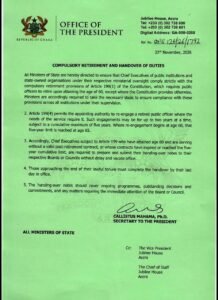
In a letter dated Monday, November 23, 2026, signed by the Secretary to the President, Dr Callistus Mahama, the Presidency instructed ministers to take the necessary measures to enforce the retirement regulations across all institutions under their respective supervision.
The directive, titled “Compulsory Retirement and Handover of Duties,” is in accordance with Article 199(1) of the 1992 Constitution, which requires public officers to retire upon attaining the age of 60, except where the Constitution provides otherwise.
The Presidency, however, explained that Article 199(4) permits the appointing authority to re-engage retired public officers where their services are required.
Such engagements may be granted for a maximum of two years at a time, subject to a cumulative period not exceeding five years. This means that public officers whose post-retirement engagement begins at age 60 would reach the maximum allowable period at age 65.
Consequently, all Chief Executives subject to Article 199 who have attained the compulsory retirement age of 60 and are operating without valid post-retirement contracts have been directed to vacate their positions.
The directive also affects Chief Executives whose post-retirement contracts have expired or who have exhausted the constitutionally permitted five-year cumulative engagement period.
“Chief Executives subject to Article 199 who have attained age 60 and are serving without a valid post-retirement contract, or whose contracts have expired or reached the five-year cumulative limit, are required to prepare and submit their handing-over notes to their respective Boards or Councils without delay and vacate office,” portions of the letter stated.
The Presidency further instructed Chief Executives approaching the end of their lawful tenure to complete all necessary handing-over processes by their final day in office.
According to the directive, the handing-over notes must contain comprehensive information on ongoing programmes, outstanding decisions and commitments, as well as matters requiring the immediate attention of the respective governing Boards or Councils.
All Ministers of State have been tasked with ensuring strict compliance with the constitutional requirements across public institutions and state-owned organisations operating under their ministerial oversight.
The letter, issued from Jubilee House in Accra, was also copied to the Vice President and the Chief of Staff.


Don’t Ban the Child, Fine the Parent – Seth Dankwah Challenges GES Two-Year Examination Ban

GES Orders Strict Enforcement of Two-Year Ban on Candidates Who Sit for BECE and WASSCE Prematurely

NPA Bill 2026: Emmanuel Duah Urges Parliament to Amend Clause 103 to Save BOST Energies

Agric Minister Fires Back at Minority Over Nkoko Nkitinkiti as NPP Chairman Is Arrested for Alleged Bird Theft

Kade Rape and Robbery Suspect Linked to 7 Attacks, Murder Dies During Police Operation

NADFFA 2027: Ghana to Host Pan-African Film and Food Festival in March

GTA Staff Demand Answers on World Cup Visa Slots, Staff Dismissals and Unpaid Allowances

Nicki Minaj Throws Her Support Behind Trump Ahead of US Midterm Elections
Ghana Faces Very Strong El Niño Threat as GMet Warns of Extreme Heat, Drought and Possible Flooding

GTA Targets Taxi Drivers in ‘Know Ghana’ Campaign to Boost Tourism

Illinois’ financial crisis could bring the state to a halt
The final 6 ‘Game of Thrones’ episodes might feel like a full season
New Season 8 Walking Dead trailer flashes forward in time
Mod turns ‘Counter-Strike’ into a ‘Tekken’ clone with fighting chickens
Meet Superman’s grandfather in new trailer for Krypton

-

 Entertainment17 hours ago
Reggie Rockstone apologises to AY Poyoo over Zen Gardens stage incident
-

 Entertainment23 hours ago
I Turned to Sarkodie When Online Trolling Became Too Much – King Promise
-

 Entertainment22 hours ago
‘If You Are Rich and Have a Pot Belly, You Are a Fool’ – BullGod
-

 General News5 hours ago
Nollywood Legend Pete Edochie Dies at 79 After Battle With Prostate Cancer
-

 Entertainment17 hours ago
Every Song I Release Is a Sermon – Perez Musik
-

 Entertainment23 hours ago
Hiplife Trinity Reunion: Why Ghana Must Celebrate Its Music Legends While They Are Alive
-

 Uncategorized23 hours ago
‘It was never intentional’ – Tic Tac apologies to AY Poyoo over stage embarrassment
-

 Education17 hours ago
Not Every Brilliant Child Comes First in Class: Are Schools Ignoring Hidden Talents?