
General News
TraffiTech-GH Fines: Radiant Media Questions Revenue Allocation, Demands Dedicated Road Safety Fund


The Radiant Media and Intelligence Hub has raised concerns about how revenue generated from Ghana’s newly introduced TraffiTech-GH traffic enforcement system will be managed, questioning whether the money will be channelled into a dedicated Road Safety Fund or absorbed into the government’s Consolidated Fund.
In an analysis authored by its Executive Director, Emmanuel Duah, the organisation argues that although the technology-driven enforcement system is expected to help curb indiscipline on Ghana’s roads, the absence of a dedicated account for road safety revenue raises questions about how the proceeds will contribute to improving road infrastructure and protecting motorists.
TraffiTech-GH became operational between November 1 and 2, 2026, following earlier postponements from September 29 and October 1.
The system is designed to detect traffic violations electronically and strengthen enforcement by the Motor Traffic and Transport Department (MTTD).
According to the analysis, the enforcement infrastructure includes fixed cameras installed at approximately 34 high-risk junctions across the country, 20 cameras mounted in vehicles, 30 handheld laser and tripod cameras, as well as Personal Digital Assistants (PDAs).
The process begins when the cameras and other devices capture suspected traffic violations. The evidence is subsequently transmitted to the MTTD’s regional back offices, where officers review and validate the violations before an Electronic Notice of Violation (ENV) is issued to the offender.
The notice is sent through an SMS from GPS-MTTD, informing the motorist of the offence and the applicable penalty.
The analysis explains that the penalties are guided by Regulation 242 of the Road Traffic Regulations, 2026 (L.I. 2519), which establishes fines based on the number of offences committed.
Under the regulation, the first, second and third offences attract a fine of GH¢120 each, equivalent to 10 penalty units, with one penalty unit valued at GH¢12.
The penalties increase progressively, with a fourth offence attracting GH¢180 and a fifth offence attracting GH¢240.
A motorist who commits a sixth offence within 24 months may face court proceedings and suspension of their driving licence.
Speeding offences attract a fine of GH¢240 for every 5km/h above the permitted speed limit, representing 20 penalty units. Other traffic violations could attract penalties of up to GH¢2,400, in addition to possible imprisonment.
Motorists have 14 days to pay their fines through the Ghana.gov platform, mobile money or the *222# option 6 service.
However, those who fail to settle their fines within the stipulated period face an additional surcharge of one per cent per day.
The analysis notes that no maximum limit for the daily surcharge has been published, raising concerns about how much the accumulated penalties could eventually become.
It further states that motorists with unpaid fines could be prevented from accessing certain services at the Driver and Vehicle Licensing Authority (DVLA).
One of the major issues highlighted by Emmanuel Duah is the revenue-sharing arrangement under the public-private partnership (PPP) governing the TraffiTech-GH system.
According to the analysis, revenue generated from traffic fines is divided between the government and the private operator, Nationwide Traffic Management and Enforcement Limited (NTMEL).
Under the arrangement, the private company receives 40 per cent of the revenue, while the government receives the remaining 60 per cent.
The analysis says this arrangement is reflected in the government’s 2022 PPP report and an assessment of the contract by Bright Simons.
It further explains that the government’s 60 per cent share is paid through the Ghana.gov platform into the Consolidated Fund.
Under Ghana’s public financial arrangements, payments made through Ghana.gov are generally transferred into the Consolidated Fund unless an Act of Parliament makes specific provisions for the revenue to be earmarked for another purpose.
However, the analysis argues that L.I. 2519 did not establish a dedicated Road Safety Fund or an escrow account to receive and manage revenue generated from TraffiTech-GH fines.
This means that the government’s share is currently treated as general government revenue rather than money specifically reserved for road safety interventions.
The organisation warns that without a legally established ring-fenced account, there is no guarantee that the revenue will be directly reinvested in road safety projects such as road markings, traffic camera maintenance, street lighting, emergency response services and compensation for accident victims.
It therefore questions whether a system introduced primarily to improve road safety should operate without a clear mechanism to ensure that part of the money collected supports the same objective.
The organisation has also drawn attention to the potential financial returns from the enforcement system, citing figures recorded during its one-week test run.
According to the analysis, the MTTD captured more than 10,000 traffic violations during the period.
Using an assumed minimum fine of GH¢300 per violation, Emmanuel Duah estimates that the offences could generate approximately GH¢3 million in fines within one week.
Based on the same figures, the analysis projects potential revenue of GH¢12 million monthly and more than GH¢144 million annually if the rate of violations and collections remains consistent.
The organisation cautions that such significant revenue could become a major source of government income without necessarily translating into visible improvements in road safety.
It argues that if the proceeds are absorbed into the Consolidated Fund, funding for road safety interventions will have to compete with other government spending priorities.
According to the analysis, this could defeat part of the purpose of introducing the technology if motorists continue to experience poorly marked roads, inadequate street lighting, limited emergency response services and other road safety challenges despite the fines being collected.
In making its case for a dedicated fund, the Radiant Media and Intelligence Hub points to the United Kingdom, particularly London boroughs, as an example of how revenue generated through traffic enforcement can support transport improvements.
The analysis cites approximately £1 billion generated by London boroughs and argues that legal requirements for reinvesting such revenue in transport provide a useful model for Ghana.
It recommends that Ghana adopt a similar approach by ensuring that a defined portion of the government’s share of TraffiTech-GH fines is committed to improving road safety rather than being treated entirely as general revenue.
Fraud concerns and public confidence
The analysis also raises concerns about the possibility of fraudulent payment demands targeting motorists using the TraffiTech-GH system.
It refers to an incident in February 2026 when seven people were reportedly arrested over fake TraffiTech-GH SMS messages demanding payments through private mobile money numbers.
The incident prompted the police to issue a warning to the public against making payments into suspicious private accounts.
Although the organisation acknowledges that the use of Ghana.gov as the central payment platform helps reduce the risk of fraud, it insists that transparency and accountability remain essential to maintaining public confidence.
It argues that motorists must be able to identify legitimate payment notices, verify the offences recorded against them and obtain official receipts for every payment made.
The organisation further insists that payments should only be made through officially approved channels, including Ghana.gov and the authorised GPS-MTTD system, rather than private mobile money accounts.
Four recommendations to government
To address the concerns surrounding the management of TraffiTech-GH revenue, the Radiant Media and Intelligence Hub has proposed four measures for consideration by the government and Parliament.
Establish a Road Safety and Emergency Response Fund
The organisation is calling on Parliament to amend L.I. 2519 to establish a dedicated Road Safety and Emergency Response Fund.
It recommends that at least 50 per cent of the government’s 60 per cent share of revenue generated from traffic fines should be earmarked for the proposed fund.
The money would be used to finance road signs and markings, street lighting, ambulance posts, MTTD regional back-office capacity and compensation for victims of road accidents.
Publish monthly revenue reports
The organisation wants the government to establish a publicly accessible dashboard showing the monthly revenue generated through TraffiTech-GH.
The dashboard should also disclose how the money is divided between the government and Nationwide Traffic Management and Enforcement Limited.
According to the analysis, regular publication of the figures would allow motorists and the general public to monitor collections and understand how the revenue is being managed.
Introduce a cap on daily surcharges and clarify appeals
The organisation is also calling for a limit on the one per cent daily surcharge imposed on motorists who fail to pay within 14 days.
It wants the authorities to clearly explain the appeal process to ensure that motorists who dispute violations have an accessible mechanism to challenge the notices and avoid excessive accumulation of penalties.
Maintain transparent and publicly supervised enforcement
The fourth recommendation is for the government to ensure that the enforcement and payment processes remain transparent and subject to public oversight.
The organisation insists that official payment receipts should clearly identify authorised channels, particularly Ghana.gov and GPS-MTTD.
It also warns against directing motorists to make payments into private mobile money accounts, stressing the need for a reliable and verifiable payment system.
Concluding its argument, the Radiant Media and Intelligence Hub maintains that the introduction of camera-based traffic enforcement is a positive development because technology can help reduce opportunities for bribery and improve compliance with road traffic regulations.
However, it argues that the success of TraffiTech-GH should not be measured only by the number of violations detected or the amount of money collected from motorists.
The organisation maintains that the revenue generated must contribute to safer roads, improved emergency response systems and better protection for road users.
It warns that although the cameras may help eliminate direct human interference in traffic enforcement, motorists could eventually view the system as another means of taxation if the money collected does not translate into visible road safety improvements.
The organisation’s position is that traffic indiscipline must be punished, but the financial proceeds from that punishment should also help build safer roads and strengthen the country’s road safety infrastructure.
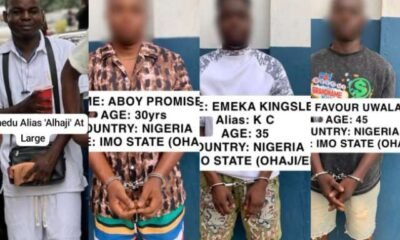
















The body of 24-year-old Joseph Owusu, a church organist in the Bronx, was reportedly discovered at a dumpsite, deepening grief among Ghanaians in the United States.
The Ghanaian community in New York has been plunged into fresh mourning following the reported discovery of the body of a 24-year-old Ghanaian man, Joseph Owusu, at a dumpsite in the Bronx, about two weeks after he went missing.
Owusu, a member and organist of the Ghana United Methodist Church in the Bronx, was reportedly found among refuse by a scrap collector.
News of his death emerged on Tuesday, November 3, 2026, bringing an end to the uncertainty surrounding his whereabouts since he was reported missing.
Members of his church community remembered him as a dedicated musician whose commitment to serving the congregation through music and his warm personality made him well-liked.
The circumstances surrounding his disappearance and death remain unclear, with further details about how his body came to be at the dumpsite still awaited.
Fresh grief for Ghanaian community
Owusu’s death comes just days after another Ghanaian, 15-year-old Javits Badu Nkansah Frimpong, was shot dead in the same New York borough.
Frimpong was killed on October 29, 2026, while on his way to school near Crotona Park in the Bronx. He was reportedly chased before being shot and later died at a hospital.
The teenager’s killing has attracted attention in both Ghana and the United States, with officials and members of the community calling for justice.
Questions remain over circumstances of death
While reports have confirmed the discovery of Owusu’s body, details about the circumstances leading to his death have not been publicly established.
There has also been no confirmed information indicating whether foul play was involved or whether anyone has been arrested in connection with the case.
The two deaths have heightened concern and sorrow among Ghanaians in New York, particularly within the Bronx community.
Owusu’s death has left members of his church and the wider Ghanaian community mourning a young man remembered for his contribution to church life, while questions remain about what happened during the two weeks he was missing.
BY: Daniel Sasu
General News
Police arrest three suspects over series of robberies targeting bank customers in Kumasi
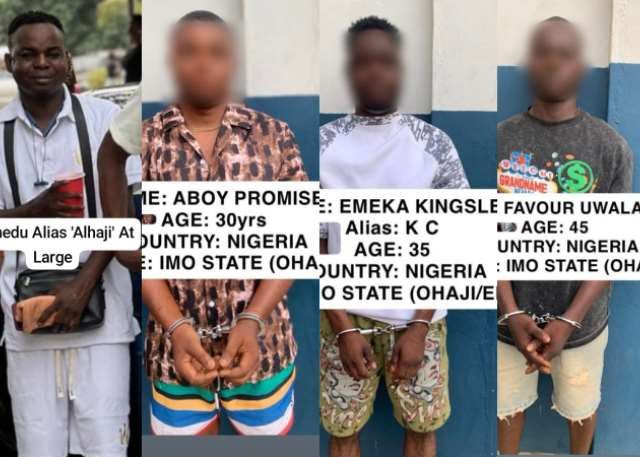
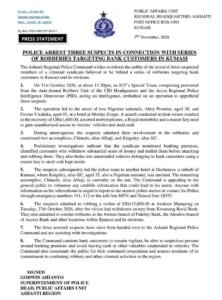
The Ashanti Regional Police Command says two Nigerian nationals and a third suspect have been arrested in connection with robberies involving customers who withdraw large sums of money from banks in Kumasi and surrounding communities.
The Ashanti Regional Police Command has arrested three suspected members of a criminal syndicate believed to be behind a series of robberies targeting bank customers in Kumasi and its environs.
In a press statement dated November 3, 2026, and signed by Superintendent Godwin Ahianyo, Head of the Public Affairs Unit, the Command said the arrests followed an intelligence-led operation conducted by a special team of the Inspector-General of Police on October 31.
The team, made up of personnel from the Anti-Armed Robbery Unit of the Criminal Investigations Department (CID) Headquarters and the Accra Regional Police Intelligence Directorate, arrested two Nigerian nationals, identified as Aboy Promise, 30, and Favour Uwalaka, 45, at a hotel in Moshie Zongo.
A search of their rooms led to the recovery of GH¢1,600, assorted mobile phones, a Royal motorbike and a master key allegedly used to gain unauthorised access to victims’ vehicles.
Suspects allegedly targeted bank customers
According to preliminary police investigations, the syndicate monitored banking premises, identified customers who withdrew substantial amounts of money and trailed them before attacking and robbing them.
The suspects also allegedly used a master key to break into unattended vehicles belonging to bank customers and steal cash kept inside.
During interrogation, the two arrested men reportedly admitted involvement in the robberies and mentioned two alleged accomplices: Chinedu, also known as Alhaji, and Kingsley, known as KC.
Police said the suspects subsequently led investigators to another hotel at Dechemso, where Kingsley, 35, was arrested. Chinedu remains at large.
Suspects linked to GH¢15,000 robbery.
The Command said the three suspects admitted to robbing a victim of GH¢15,000 at Asokore Mampong on October 27, after the victim had withdrawn money from Kwamang Rural Bank.
They also reportedly admitted to similar robberies at the Atonsu branch of Fidelity Bank, the Ahodwo branch of Access Bank and other locations within Kumasi.
The three arrested suspects have been handed over to the Ashanti Regional Police Command, which is assisting with the investigation.
Police have appealed to the public to provide credible information that could lead to the arrest of the remaining suspect, Chinedu. People can report information to the nearest police station or through emergency numbers 191, 112, and 18555.
The Command has urged bank customers to remain vigilant around banking premises and avoid leaving cash or valuables unattended in vehicles.
By: Daniel Sasu.
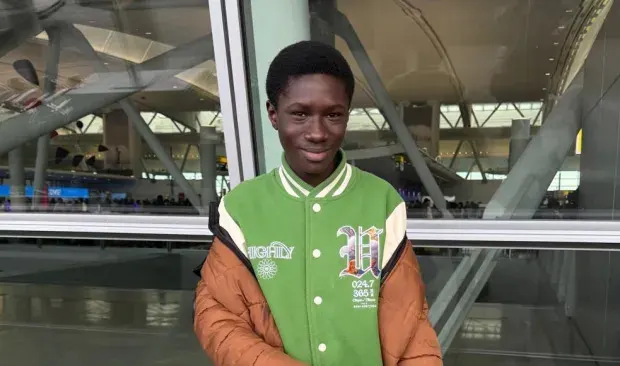
The United States Embassy in Ghana has expressed sadness over the death of 15-year-old Javits Frimpong, a Ghanaian student who was fatally shot in New York City.
In a statement shared on its official X page, the Embassy said it was deeply saddened by the teenager’s tragic death and extended its condolences to his family, friends and everyone mourning his loss in Ghana and the United States.
The Embassy also expressed sympathy to all those affected by the incident, saying they remained in its thoughts during the difficult period.
“The U.S. Embassy is deeply saddened by the tragic death in New York City of Javits Frimpong, a 15-year-old student of Ghanaian descent. We hold Javits’ family, friends, and all who mourn him in Ghana and the United States in our thoughts,” the statement read.
Javits Frimpong was reportedly shot on Thursday, October 29, 2026, while walking to school in the Bronx, New York. Following the incident, he was rushed to a nearby hospital, where he was pronounced dead.
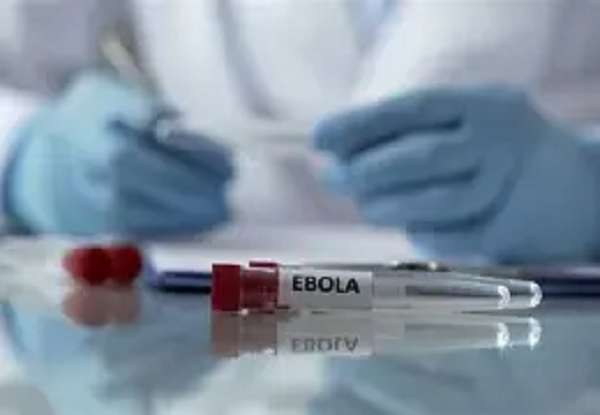
The Ministry of Health has introduced a 21-day monitoring programme for travellers arriving in Ghana from countries experiencing active transmission of the Bundibugyo strain of Ebola, as part of efforts to prevent the disease from entering and spreading within the country.
Under the new directive, the Ghana Health Service (GHS) will maintain contact with affected travellers throughout the monitoring period to check on their health. Travellers are expected to remain reachable and promptly report any symptoms they experience.
In a statement released on Tuesday, November 3, the Ministry explained that the measure forms part of additional public health measures being enforced at Ghana’s international airports to guard against the importation and spread of the virus.
“Passengers arriving from countries with ongoing transmission will be monitored for up to 21 days. The Ghana Health Service will contact them for follow-up, and they must keep reachable contact details and report any symptoms immediately to the designated contact,” the statement indicated.
The Ministry further disclosed that all passengers entering Ghana would be subjected to health screening by Port Health officers. The exercise will include temperature checks, examination of health declaration forms and assessments of passengers’ travel histories.
Travellers must also provide information about any visits to or transit through countries affected by Ebola within the previous 21 days. They are equally required to disclose any contact with individuals suspected or confirmed to have contracted the disease.
Passengers who exhibit symptoms including fever, vomiting, diarrhoea, extreme weakness or unexplained bleeding will be referred for further medical evaluation. Depending on their condition, they may be temporarily isolated and provided with the necessary medical care.
The Ministry cautioned that providing inaccurate information, hiding symptoms or refusing to comply with the screening process could attract public health measures in accordance with Ghanaian laws.
It has also instructed hotels, conference centres and other similar facilities to notify the nearest district health directorate whenever they accommodate guests arriving from Ebola-affected countries. Such establishments are also expected to keep the guests’ contact information for follow-up purposes.
Despite the additional precautions, the Ministry emphasised that Ghana has not recorded any confirmed case of Ebola, describing the interventions as preventive measures aimed at protecting public health.
It urged Ghanaians to obtain information about the disease from official channels, particularly the Ministry of Health and the Ghana Health Service, while cautioning against the circulation of unverified reports.
The announcement comes amid concerns over the spread of Ebola in parts of Africa, where the latest outbreak has reportedly resulted in more than 5,300 deaths, with the Democratic Republic of Congo (DRC) accounting for the majority.
According to the Africa Centres for Disease Control and Prevention (Africa CDC), more than 10,400 cases have been confirmed since the outbreak was declared in May, with the fatality rate exceeding 50 per cent.
Beyond the DRC, the outbreak has also affected other African countries, including Uganda and Kenya, which reportedly recorded their first-ever Ebola infections in October.
General News
Ghana Faces Very Strong El Niño Threat as GMet Warns of Extreme Heat, Drought and Possible Flooding
Ghana could experience unusually hot, dry and dusty weather conditions between November 2026 and April 2027 as a very strong El Niño phenomenon develops in the Pacific Ocean, prompting concerns over water security, food production, public health and the country’s preparedness for potential disasters.
The Ghana Meteorological Department (GMet), in a six-page advisory released on October 30, 2026, warned that the developing El Niño is intensifying, citing data from the National Oceanic and Atmospheric Administration (NOAA), the World Meteorological Organisation (WMO) and the International Research Institute for Climate and Society (IRI).
According to the advisory, there is a 96 per cent probability that the phenomenon will reach very strong intensity between November 2026 and January 2027. It is expected to peak within the same period before gradually weakening during the first half of 2027.
The development is expected to influence Ghana’s weather patterns, particularly during the dry season, with hotter temperatures, reduced rainfall and increased dust and harmattan conditions anticipated from late November 2026 through March 2027.
GMet also projects below-normal rainfall across most parts of Ghana between October and December 2026. However, the reduced rainfall outlook does not eliminate the possibility of sudden heavy downpours and localised flooding, particularly in southern Ghana and parts of the inland Greater Accra, Central, Volta, Eastern, Bono, Savannah, North East and Upper West regions.
The advisory further identifies February to April 2027 as the period when heat stress could become particularly severe, especially in northern Ghana.
Forecast temperatures include 38°C in Bolgatanga, 36°C in Tamale and 34°C in Kumasi, raising concerns about the impact of prolonged heat on vulnerable populations, agricultural activities and livestock.
Other anticipated risks include bushfires, water shortages, pressure on crops and livestock, increased dust and harmattan conditions, as well as a heightened seasonal risk of meningitis in northern Ghana.
Beyond the immediate dry-season concerns, the outlook for Ghana’s 2027 rainy season remains uncertain.
The advisory indicates that rainfall could arrive late or remain weak if El Niño weakens slowly. However, a possible transition to La Niña conditions around the middle of 2027 could trigger heavier rainfall, increasing the risk of flooding and potential spillage from the Volta Lake.
The current situation has been compared with previous strong El Niño episodes recorded in 1982/83, 1997/98 and 2015/16, highlighting the need for early preparation and effective disaster management.
Reacting to the warning, Emmanuel Duah, Executive Director of Radiant Media and Intelligence Hub, has called for urgent national action, warning that Ghana has a limited window to prepare for both the expected dry conditions and the possible return of heavy rainfall.
In a statement titled How Prepared Will We Be?, Mr Duah argued that the country must use the period before the rains return to address weaknesses in water management, sanitation, agriculture, healthcare and disaster preparedness.
He outlined seven proposed measures divided into preparations for the hot, dry and dusty season and measures to address potential flooding.
Activate a National El Niño Task Force
Mr Duah called for the immediate activation of a National El Niño Task Force, as recommended by GMet.
He proposed that the team should include representatives from GMet, the National Disaster Management Organisation (NADMO), Volta River Authority (VRA), Ghana Water Limited, the Ministry of Food and Agriculture, Ghana Health Service and the Energy Commission.
The task force, he said, should monitor developments weekly, particularly Akosombo Dam water levels and national food buffer stocks, to ensure that potential challenges are identified early.
Strengthen Water Security
He urged Ghana Water Limited to publish a water rationing plan ahead of the anticipated dry conditions rather than wait until shortages become severe.
He also proposed the rehabilitation of boreholes in northern Ghana to improve access to water for communities that could be affected by prolonged dry weather.
Additionally, he called on the VRA to carefully manage water retention at the Akosombo and Kpong dams to reduce the possibility of emergency spillage when rainfall patterns change.
Introduce Public Health Protection Measures
On health, Mr Duah urged the Ghana Health Service to pre-position meningitis vaccines in the Upper East, Upper West, North East and Savannah regions in anticipation of increased seasonal risks.
He also called on Metropolitan, Municipal and District Assemblies (MMDAs) to issue heat advisories to residents, recommending that people avoid strenuous outdoor activities between 12 noon and 3 p.m.
Particular attention, he said, should be given to protecting schoolchildren, market women and other people whose daily activities expose them to prolonged heat.
Protect Food Production and Livestock
The Executive Director also called on the Ministry of Food and Agriculture to provide farmers with timely guidance on planting schedules, including advising them to delay planting until GMet provides clearer information on the 2027 rainfall outlook.
He further recommended the distribution of drought-tolerant seeds and livestock feed support, particularly to farmers in northern Ghana, where prolonged dry conditions could affect agricultural production.
Measures Needed Before the Rains Return
Mr Duah stressed that preparations should not end with the management of the dry season, warning that the return of rainfall could bring another round of flooding if the necessary preventive measures are not implemented.
Desilt Drains and Enforce Building Regulations
He called on MMDAs in Accra, Kumasi, Tamale and Sekondi to begin desilting major drainage systems, including the Odaw and Korle drains, as well as other primary drains, before March 2027.
He also urged authorities to enforce existing restrictions against building on waterways immediately instead of waiting until flooding occurs before taking action.
Strengthen NADMO and VRA Early Warning Systems
The statement further called on NADMO to pre-position relief supplies, boats and life jackets in flood-prone areas across the Volta, Greater Accra, Central and Eastern regions.
Mr Duah also urged the VRA to provide at least 72 hours’ warning before any planned spillage from the Volta Lake, drawing lessons from the 2023 spillage and its impact on affected communities.
Improve Public Communication and Early Warnings
As part of efforts to ensure that communities understand the potential risks, he proposed translating GMet’s advisory into 12 local languages and distributing the information through radio stations across the country.
He also called on telecommunications companies to use SMS alerts to notify residents about extreme heat conditions and sudden heavy rainfall, particularly in vulnerable communities.
In its concluding assessment, Radiant Media and Intelligence Hub maintained that although El Niño is a natural climate phenomenon, the disasters associated with its effects can be reduced through proper planning and effective governance.
Mr Duah argued that GMet had fulfilled an important responsibility by issuing an early warning, but the real test would be whether government institutions, particularly District Assemblies, translate the forecasts into practical preventive measures.
He warned that Ghana risks repeating a cycle of experiencing extreme heat and dry conditions in the early part of the year, followed by devastating floods when the rains return.
“We cannot afford to burn in February and drown in June of the same year,” the statement cautioned, urging authorities to use the four-month preparation window to strengthen the country’s resilience against the anticipated weather conditions.
https://web.facebook.com/share/p/19Xz6q5zaH/?mibextid=wwXIfr

NADFFA 2027 launched in Accra to celebrate African cinema, cuisine and culture

Ned Nwoko warns bloggers over false death reports about Regina Daniels, threatens legal action

Abla Dzifa Gomashie commissions 12-room guest lodge at GTEC

IRAWMA 2025: Shatta Wale Wins 3 Major Awards Including Best Music Video

Samini Secures Promotional Deal with Audiomack for Upcoming Album “THE ORIGIN8A”

AirtelTigo losing GH₵20m monthly; total debts exceed $200million – Sam George


-

 General News1 week ago
GTA Staff Demand Answers on World Cup Visa Slots, Staff Dismissals and Unpaid Allowances
-

 General News2 weeks ago
FOKLEX MEDIA AWARDS COMMENDS PRINCE KWAW GYIMAH AND OWASS FM TEAM FOR PROFESSIONALISM DURING KWAME DZOKOTO INCIDENT
-

 General News2 weeks ago
SAMMY GYAMFI’S “MINE WITHOUT LICENCE” REMARK SPARKS FRESH GALAMSEY DEBATE
-

 General News1 week ago
Nicki Minaj Throws Her Support Behind Trump Ahead of US Midterm Elections
-

 Entertainment1 week ago
GTA Targets Taxi Drivers in ‘Know Ghana’ Campaign to Boost Tourism
-

 Education1 week ago
Can Students Solve Disagreements Without Fighting? Why Schools Should Teach Conflict Resolution
-

 Lifestyle1 week ago
One More Video Until 2 AM: Why We Keep Stealing Sleep from Ourselves
-
 Lifestyle1 week ago
In Ghana, Everyone Wants to Be Called Boss — But Who Is Doing the Actual Work?