
General News
Day Students Deserve Equal Support Under Free SHS and Free TVET – Seth Afum A. Dankwah

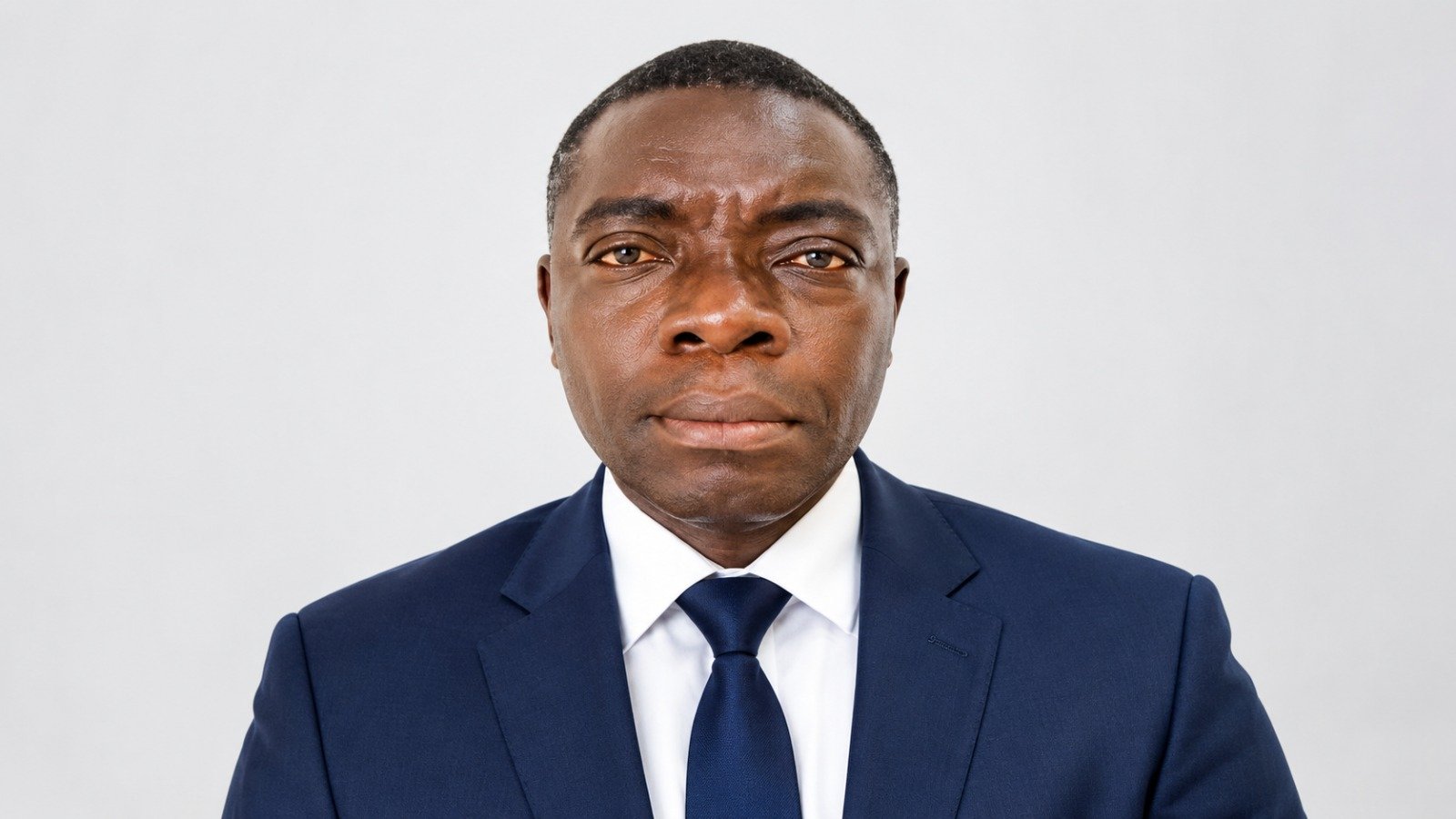
Concerns have been raised over the welfare of day students under Ghana’s Free Senior High School (Free SHS) and Free Technical and Vocational Education and Training (Free TVET) programmes, with calls for the government to review the support provided to students who live in hostels away from their families.
Seth Afum A. Dankwah of J. G. Knol Technical Institute in Adukrom, Akuapem, Eastern Region, argues that many students classified as day students are facing challenges similar to those of boarding students but do not receive the same level of government support.
In an article dated Friday, November 6, 2026, he said the current arrangement has created an unfair situation in which some day students struggle to meet their basic needs despite attending the same schools and receiving the same education as their boarding counterparts.
He explained that while boarding students receive free tuition, accommodation and three meals a day, day students generally receive tuition support and one meal, usually lunch, during school days.
According to him, the policy was initially based on the assumption that day students lived with their parents and could therefore depend on their families for breakfast and supper.
However, he believes that assumption no longer reflects the circumstances of many students across the country.
He noted that some students are admitted to schools located far from their hometowns and farming communities, leaving them with little choice but to rent rooms or stay in private hostels near their schools.
These students, he said, often live without their parents, guardians or close relatives, yet are still classified as day students and consequently miss out on the additional feeding and accommodation support provided to boarders.
Dankwah described the situation as particularly difficult for students whose parents struggle financially to pay for accommodation, food, water, electricity, cooking fuel and other necessities.
He painted a picture of the difference between the daily experiences of boarding students and day students living in hostels.
While boarding students wake up to breakfast provided by the state, attend classes, receive lunch and supper, and return to supervised dormitories, some day students reportedly begin their mornings without food because they have no money to purchase breakfast.
After receiving the one meal provided at school, they must find their own means of securing food and other necessities for the rest of the day.
He further observed that some of these students live in private hostels that are not under the direct supervision of school authorities, leaving them without the same level of security and monitoring available to boarding students.
The situation, he argued, places additional financial pressure on parents who may end up spending more on their children than parents whose wards have secured boarding places.
He questioned why government support should depend largely on whether a student is fortunate enough to obtain a boarding placement when both categories of students have passed the same Basic Education Certificate Examination (BECE) and are pursuing the same educational goals.
Three major challenges facing day students
Dankwah identified welfare, discipline and safety, as well as attendance, as three major areas affected by the situation.
Hunger and students’ welfare
He warned that hunger can negatively affect students’ ability to concentrate, participate in lessons and perform academically.
According to him, some students living in hostels report to school without breakfast and may struggle to secure food after receiving their school-provided lunch.
He added that some students are sometimes forced to seek financial assistance from teachers and their colleagues to meet their basic needs.
He stressed that expecting such students to perform academically at the same level as their peers without addressing their welfare challenges could undermine the objectives of Free SHS and Free TVET.
Discipline and safety concerns
He also raised concerns about the safety of students living in private hostels outside school premises.
Unlike boarding students, whose movements and activities are monitored by housemasters and housemistresses, day students in private accommodation may not receive the same level of supervision.
He explained that some students could be exposed to negative influences, miss evening preparation sessions or engage in activities that may affect their academic performance and discipline.
He further argued that school authorities sometimes face criticism when incidents involving students occur in private hostels, even though those facilities are not under their direct control.
Irregular attendance and possible dropouts
The financial difficulties associated with private accommodation could also affect school attendance, according to Dankwah.
He explained that when parents are unable to pay hostel rent or provide money for food and other necessities, some students may be forced to return to their hometowns or stay away from school.
Others may become irregular in attendance or be seen roaming around town during school hours.
He maintained that such situations should not automatically be interpreted as laziness or a lack of interest in education, arguing that financial hardship may be the actual reason behind their absence.
Three proposals to address the inequality
While acknowledging the importance of Free SHS and Free TVET, Dankwah emphasised that his concerns are not intended to undermine the programmes but to encourage government to make them more inclusive.
He proposed three measures that could improve the welfare of day students, particularly those living in hostels away from their families.
Increase feeding support for day students
He called on the government to consider increasing the number of meals provided to day students from one to two per day.
He also suggested extending feeding support to weekends, particularly for students who can demonstrate that they live in hostels far from their homes and do not have family members to depend on for food.
He believes an additional meal could help reduce hunger and prevent some students from abandoning their education because of financial difficulties.
Introduce hostel or transport allowances
Dankwah further proposed the introduction of modest hostel allowances or transport support for day students who live far away from their families.
He argued that even a small but consistent financial allowance could help parents meet some of the costs associated with their children’s accommodation and daily movement.
He said such assistance could also improve school attendance and provide students with a more stable learning environment.
Expand boarding infrastructure and equip technical workshops
He identified investment in school infrastructure as another important solution.
According to him, many schools lack sufficient dormitory facilities to accommodate students who would otherwise prefer boarding arrangements.
He therefore called for the construction of additional dormitories to reduce the number of students forced to seek accommodation in private hostels.
He also urged the government to invest in technical workshops and provide the necessary equipment to ensure that students in TVET institutions acquire practical skills that can prepare them for employment and entrepreneurship.
He stressed that properly equipped workshops would enable students to develop skills in building, repairing, creating and providing services that could contribute to national development.
Dankwah appealed to government, Members of Parliament, District Assemblies, the Ghana Education Trust Fund (GETFund), religious organisations, alumni groups, non-governmental organisations and philanthropists to pay greater attention to the challenges facing day students.
He urged stakeholders to consider the circumstances of students who leave their hometowns to pursue secondary and technical education but struggle to meet their basic needs because they do not have access to boarding facilities.
He maintained that although government may face financial constraints in providing identical support to every student, fairness should not necessarily mean giving everyone the same amount of money.
Rather, he argued that the focus should be on ensuring that every student receives the basic care and support needed to remain in school and complete their education.
He concluded that the success of Free SHS and Free TVET should not be measured only by the number of students admitted into second-cycle institutions but also by whether those students can access the necessary welfare support to complete their education.
His central message is that students should not be disadvantaged because of their admission status or the availability of boarding facilities.
Day students, he insists, are Ghanaians too and deserve attention, protection and support under the country’s free secondary and technical education programmes.









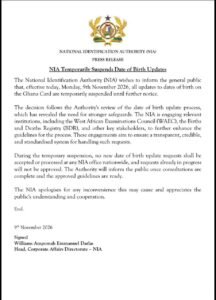
The National Identification Authority (NIA) has announced the suspension of all requests for date of birth changes on the Ghana Card until further notice.
In a statement issued on November 9, the Authority announced that the suspension will remain in force until further notice as it reviews and strengthens the procedures governing date of birth amendments.
According to the NIA, an internal review of its existing date of birth update process revealed the need to introduce stronger safeguards to ensure such requests are handled more effectively.
The Authority disclosed that it is engaging relevant institutions, including the West African Examinations Council (WAEC), the Births and Deaths Registry (BDR), and other key stakeholders, to develop stronger guidelines for processing date of birth changes.
The consultations are expected to establish a more transparent, credible and standardised system for handling applications involving amendments to dates of birth on the Ghana Card.
The NIA further clarified that no new applications for date of birth changes will be accepted or processed at any of its offices nationwide during the suspension period.
It added that applications already submitted and undergoing processing will also not be approved until further notice.
The Authority assured the public that it will communicate further once consultations have been completed and the revised guidelines are ready for implementation.
Meanwhile, the NIA has apologised for any inconvenience the temporary suspension may cause and appealed for the public’s understanding and cooperation.
The statement was signed by Williams Ampomah Emmanuel Darlas, Head of the Corporate Affairs Directorate of the National Identification Authority, and dated November 9, 2026.
In an industry where some voices are heard every morning, familiar faces appear on television screens, and certain journalists command large audiences, it is easy to associate visibility with excellence. But when the conversation turns to who deserves to be called Journalist of the Year, an important question emerges: what exactly are we measuring?
Is it the number of people who listen to a journalist? The popularity of their programme? Their ability to hold conversations, interview public figures and command attention in the studio? Or should the recognition go beyond these visible achievements?
Journalism is more than being behind a microphone or in front of a camera. It is a profession built on the responsibility to inform, investigate, question, verify and hold power accountable. While broadcasting provides an important platform for these responsibilities, occupying that platform does not automatically establish professional excellence.
A journalist’s contribution should be reflected in the quality of their work. Accuracy, originality, depth of research, fairness, ethical conduct and public impact are essential considerations. The ability to uncover stories that would otherwise remain untold, challenge misinformation, question institutional failures and give attention to overlooked communities is equally significant.
This does not diminish the work of broadcasters. A presenter who consistently asks difficult questions, challenges public officials, investigates public concerns and promotes meaningful discussions is making a valuable journalistic contribution. In fact, some of the most consequential journalism takes place through radio and television programmes.
However, popularity should not become the ultimate measure of professional achievement. A journalist may have an impressive audience and considerable public influence, but the more important question is what that influence achieves. Does it improve public understanding? Does it encourage accountability? Does it bring important issues to light? Does it provide information that people can trust?
There are also journalists whose work rarely attracts public applause. They spend time in communities, pursue difficult investigations, verify information and report stories that may never generate trending conversations. Their contributions may be less visible, but their work remains essential to the profession.
Ultimately, being Journalist of the Year should not simply be about who is the most recognised personality in the media. It should be about who demonstrates an exceptional commitment to the principles and responsibilities of journalism.
Perhaps the better question is not who speaks to the largest audience, but who uses their platform, skills and professional responsibility to make the greatest contribution to society.
Because journalism should not be measured merely by how many people hear your voice, but by the value of what that voice brings to the public.
Source: Benedicta Yaa Ohenewaa Asamoah
General News
Importers and Exporters Association of Ghana Partners ICSG to Strengthen Cargo Insurance Claims Support

The Importers and Exporters Association of Ghana (IEAG) has partnered with Insurance Claims Specialist Group (ICSG) Limited to strengthen cargo loss assessment and insurance claims management services for businesses as Ghana prepares to enforce its compulsory local marine cargo insurance framework.
The partnership is aimed at helping importers and exporters recover losses arising from damaged or missing consignments by providing specialised technical support throughout the insurance claims process.
According to IEAG, having insurance cover alone does not guarantee adequate protection for businesses, as many traders lack the expertise required to properly document cargo losses, assess damages and pursue compensation from insurance providers.
Executive Secretary of IEAG, Samson Asaki Awingobit, said the collaboration would address this challenge by helping businesses understand and navigate the claims process more effectively.
“Securing insurance cover is only one part of effective risk management. Knowing how to properly document, assess and pursue claims when losses occur is equally important,” he said.
Mr Awingobit noted that the availability of reliable local claims assessment services would be critical to building confidence in Ghana’s marine cargo insurance system, particularly as more insurance transactions are handled within the country.
Chief Executive Officer of ICSG, Dennis Tufour, also stressed the importance of effective cargo loss assessment, explaining that losses involving imported goods could have wider consequences beyond the financial value of the consignments.
He said such losses could affect business capital, contractual obligations, employment and the ability of companies to maintain their operations.
“Marine cargo insurance is not merely paperwork at the port. It is protection for capital, contracts, jobs and business continuity,” he stated.
Under the agreement, ICSG will provide professional cargo inspection and loss assessment services, including examining damaged consignments, determining the probable causes and extent of losses, gathering supporting evidence and preparing assessment reports to support insurance claims.
The partnership will also introduce a public education campaign using radio, television, print and digital platforms to improve awareness of marine cargo insurance and claims management.
The campaign will cover insurance requirements, policy conditions, claims procedures, timely reporting of losses and preventive measures businesses can adopt to minimise cargo damage.
Small and medium-sized enterprises (SMEs) will receive particular attention because of their limited financial capacity to absorb substantial losses resulting from damaged or missing goods.
Mr Tufour has consequently encouraged businesses to adopt three important practices when dealing with cargo insurance: “Insure correctly. Report promptly. Document professionally.”
The partnership comes as Ghana moves towards strengthening its local marine cargo insurance framework, with effective loss assessment and claims management expected to be important in ensuring that importers and exporters receive the protection and compensation they need when cargo losses occur.
Source: Citi Newsroom

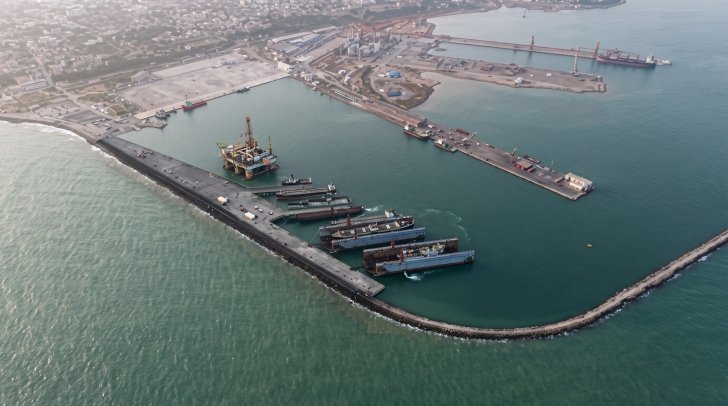
Ghana’s maritime industry is set for a major boost as construction begins on a US$137 million integrated ship repair and maintenance facility at the Takoradi Port in the Western Region.
Known as Project Shiprite, the facility is expected to position Ghana as a major maritime services hub in the Gulf of Guinea while creating up to 430 direct employment opportunities.
The project, being developed by Prime Meridian Docks (PMD) Ghana Limited in partnership with the Ghana Ports and Harbours Authority (GPHA), is scheduled to break ground on Tuesday, November 10, 2026.
President John Dramani Mahama is expected to attend the ceremony alongside the Transport Minister, industry stakeholders, investors and other project partners.
Facility to handle vessels up to 200 metres
When completed, Project Shiprite will provide modern commercial ship repair and dry-docking services for vessels measuring up to 200 metres in length.
The development is expected to address a major gap in maritime infrastructure across the Gulf of Guinea, where vessels currently travel long distances to access specialised ship repair facilities.
Ships operating in the region often have to sail for between 10 and 14 days to facilities in Walvis Bay, Namibia, or Las Palmas, Spain, for mandatory dry-docking and other maintenance services.
The Takoradi facility is expected to reduce these long journeys, lower operational costs, minimise vessel downtime and cut fuel consumption and emissions.
430 direct jobs expected
Beyond strengthening Ghana’s maritime infrastructure, the project is expected to create up to 430 direct jobs and provide business opportunities for local suppliers, contractors and service providers.
It will also support technical training and professional development, particularly for Ghanaian workers seeking opportunities in the maritime engineering and ship maintenance sectors.
As part of efforts to promote women’s participation in the industry, Project Shiprite will receive a US$300,000 grant from the Private Infrastructure Development Group (PIDG) to implement a 24-month Gender Impact Enhancement Programme.
The initiative will provide skills development, professional certification and practical industry exposure to women seeking careers in the facility’s technical workforce.
Ghanaian and international investors support project
The US$137 million investment is being financed through a partnership involving local and international investors, development finance institutions and private-sector partners.
Prime Meridian Docks Ghana Limited is developing the project under a 25-year concession agreement with the Ghana Ports and Harbours Authority.
The financing consortium includes PIDG, ARM-Harith Infrastructure Fund, African Export-Import Bank, African Development Bank, Trade and Development Bank, Petra Pension Schemes and Origen Private Debt Fund.
The project’s financial close was achieved in 2026, clearing the way for construction to commence.
Government targets regional maritime hub status
The development forms part of Ghana’s broader ambition to expand its maritime infrastructure, attract international investment and strengthen its position in regional shipping and logistics.
Director-General of the Ghana Ports and Harbours Authority, Major General Paul Seidu Tanye-Kulono, said Project Shiprite advances the authority’s objective of opening Ghana’s maritime market to ship repair and maintenance businesses.
He expressed confidence that the facility would help establish Takoradi Port as a leading destination for ship repair and related services in the region.
Chief Executive Officer of Prime Meridian Docks Ghana Limited, Stanley Ahorlu, also said the company was focused on delivering a reliable ship repair facility, developing local technical skills and creating opportunities for Ghanaian businesses.
The project was previously highlighted as a flagship investment under the UK-Ghana Growth Partnership signed in London in June 2026.
When completed, Project Shiprite is expected to reduce the need for vessels operating in the Gulf of Guinea to seek maintenance services outside the region, retain more foreign exchange within Africa and strengthen Ghana’s maritime economy.

The Media Foundation for West Africa (MFWA) has called for clear governance structures, transparent operational guidelines and strong accountability measures to guide the proposed GH¢10 million Media Development Fund announced by President John Dramani Mahama.
The Foundation says the success of the initiative will depend not merely on the amount allocated but also on how the money is managed, who qualifies for assistance and the safeguards put in place to prevent political interference and misuse of public funds.
Speaking on Joy News’ PM Express programme on Monday, November 9, MFWA Programme Manager, Kwaku Krobea Asante, welcomed the government’s announcement but cautioned that Ghana must learn from previous attempts to establish a similar fund.
According to him, the country needs to establish clear structures covering the fund’s administration, legal framework, governance arrangements and operational procedures before disbursement begins.
“We need to deal with the structures that are put in place, the government, the legal and governance safeguards, and the clear operational structures,” he said.
Mr Asante argued that Ghana should draw lessons from countries such as France, those in Scandinavia, Senegal, Benin, Burkina Faso and Niger, where different forms of state-supported media development arrangements exist.
However, he cautioned that the major challenge is ensuring that such funds are used strictly for their intended purposes.
MFWA recalls concerns over previous GH¢1m media fund
The MFWA Programme Manager recalled that in 2013, the Foundation and other civil society organisations raised concerns about the management of an earlier GH¢1 million allocation intended for media development.
He explained that the Ministry of Information at the time indicated that the money had been used to purchase laptops and other equipment for journalists and media organisations.
However, questions remained unanswered regarding the procurement process, the criteria used to select beneficiaries and the quality of the equipment distributed.
“We don’t have answers to those questions,” he stated.
He said the experience demonstrated why the latest initiative must be supported by transparent procedures and clearly defined responsibilities to prevent similar controversies.
Concerns over political influence and beneficiaries
Mr Asante also questioned how journalists and media organisations would be selected to benefit from the proposed fund.
He called for clear eligibility requirements and safeguards to ensure that public resources are not channelled towards organisations or individuals because of their political affiliations.
He particularly raised concerns about media organisations with strong partisan political interests, arguing that the fund should not become a mechanism for financing the agendas of political parties.
According to him, the process must be independent, transparent and accessible to qualified media practitioners without political considerations influencing decisions.
Mahama announces GH¢10m allocation
President John Dramani Mahama announced a GH¢10 million allocation in the 2027 national budget as seed money for the reactivation of the Media Development Fund.
The announcement was made at the 30th Ghana Journalists Association (GJA) Media Awards in Accra on Saturday, November 7, 2026.
The fund is expected to support journalists’ welfare, professional development, investigative reporting, digital literacy and safety training.
The President also indicated his intention to engage corporate institutions, including KGL Group and the Bank of Ghana, to contribute additional resources to strengthen the initiative.
He assured journalists that the government would work with the GJA and other stakeholders to translate the commitment into practical support while respecting editorial independence.
MFWA urges stakeholders to look beyond GH¢10m
While acknowledging the potential benefits of the allocation, Mr Asante stressed that stakeholders must look beyond the initial GH¢10 million and focus on establishing a sustainable funding arrangement.
He maintained that the fund could provide significant support to Ghana’s media industry, particularly at a time when several media organisations are struggling with operational costs and the financial demands of quality journalism.
He therefore urged the government, media associations and other stakeholders to prioritise transparency, accountability and institutional independence in developing the fund’s operational framework.
The MFWA’s concerns have renewed attention on the need to ensure that the revived Media Development Fund does not suffer the same challenges that affected its earlier implementation.
For the Foundation, the real test of the GH¢10 million initiative will not simply be the announcement of the money, but whether it can be administered fairly, independently and transparently for the benefit of Ghana’s media industry.

The History of Birthdays: How an Ancient Tradition Became a Worldwide Celebration

Bisa Kdei Says He Sometimes Gets Surprised by His Own Songwriting Skills

Before Smartphones Took Over, Ghanaian Families Gathered Around the Radio – A Tradition Worth Remembering

IRAWMA 2025: Shatta Wale Wins 3 Major Awards Including Best Music Video

AirtelTigo losing GH₵20m monthly; total debts exceed $200million – Sam George

Samini Secures Promotional Deal with Audiomack for Upcoming Album “THE ORIGIN8A”


-
 General News14 hours ago
Beyond the Fame: What Makes a Journalist of the Year?
-

 General News16 hours ago
Meet 5 Ghanaian Media Personalities Who Have Declared Parliamentary Ambitions Ahead of 2028 Elections
-
 Culture14 hours ago
Ghana’s Rich Cultural Heritage: A Beautiful Blend of Tradition, Identity and Modern Life
-
 General News15 hours ago
Importers and Exporters Association of Ghana Partners ICSG to Strengthen Cargo Insurance Claims Support
-

 Politics13 hours ago
Passport Scandal: NPP Lawyer K.K. Serbeh Accuses NDC Of Double Standard, Demands Truth Over Diplomatic Passports
-

 Lifestyle14 hours ago
Why Do We Take So Long to Leave the House? The Ghanaian Habit of Saying “I’m Coming” When We’re Not Ready
-

 General News16 hours ago
GH¢10m Media Fund: ‘We Need Clear Rules to Prevent Political Interference’ – MFWA
-

 Politics16 hours ago
NDC, NPP Do Not Want Independent Journalism to Thrive – Ashigbey